Diagnosis
Botrytis Recognition and Treatment: Early Detection and Prevention
Botrytis cinerea (gray mold) is the most feared fungus in cannabis cultivation. It destroys flowers from inside, is difficult to treat, and prevention is the only reliable approach. This guide shows how to detect botrytis early, respond correctly, and prevent it through VPD and climate management.
Biology and Conditions
What is Botrytis?
Botrytis cinerea is a necrotroph fungus that invades flowers and destroys cell walls through enzymatic degradation. Spores are extremely resistant and survive years in soil and on tools.
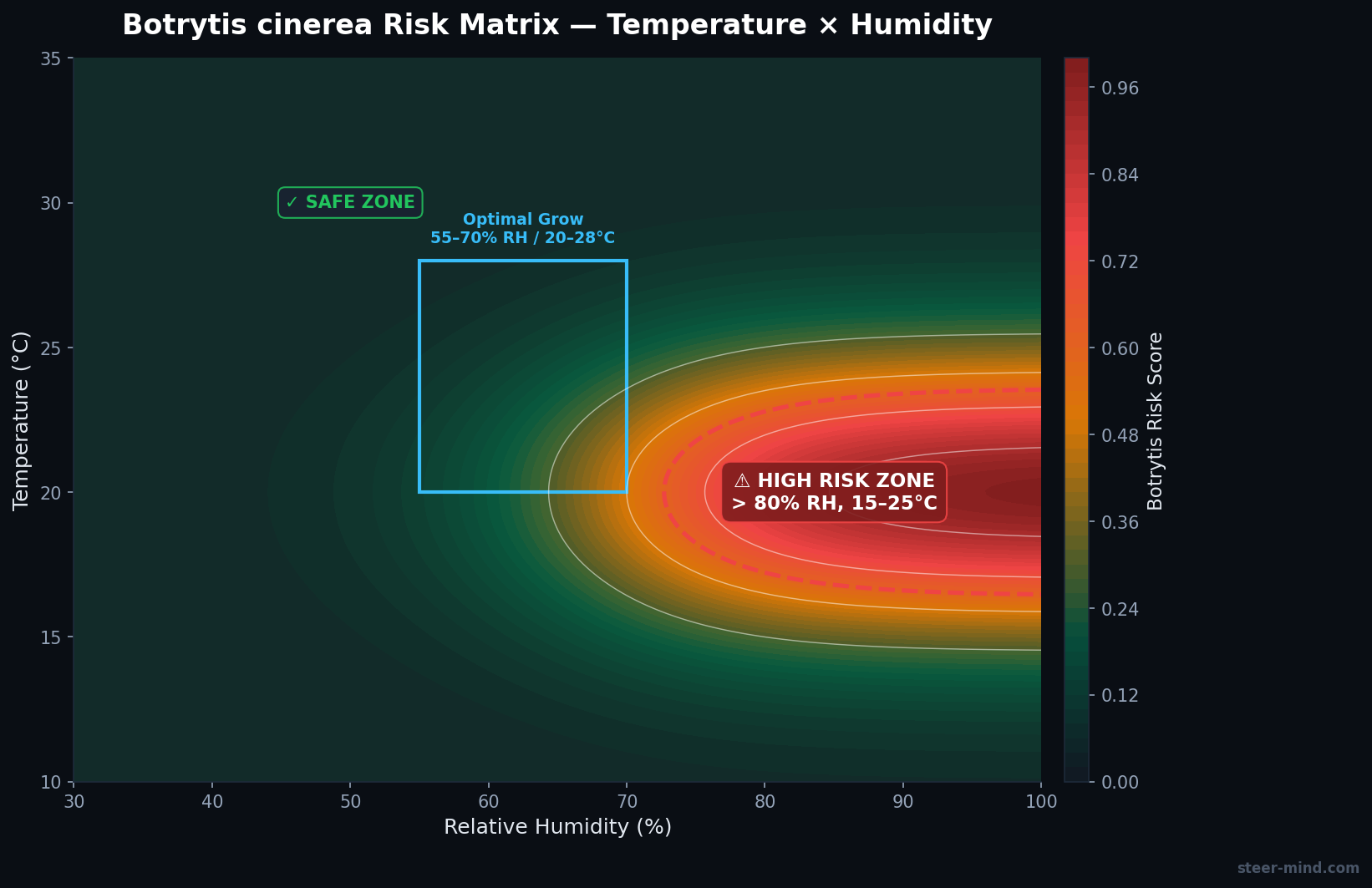
Optimal conditions for Botrytis
- Temperature: 18–25°C (optimal ~20°C)
- Humidity: >85% RH (critical), >60% RH already risky
- Free water: Botrytis requires water droplets on leaves/flowers
- Air stagnation: Poor circulation concentrates local humidity
Critical point: Botrytis cannot grow on dry flowers. Relative humidity below 50% makes botrytis impossible.
Early Detection: First Signs
Typical symptoms
- Brown spots: Single brown patches IN THE MIDDLE of dense flowers, not edges. This is pathognomonic.
- Gray coating: Fine, fuzzy gray-brown powder over the spot (sporulation)
- Interior rot: If you break open the flower, the inside is mushy and decayed, brown
- Smell: A musty, moldy odor comes from the flower
- Rapid spread: Within 2–3 days, affected area doubles
Where to look
- Dense, large flowers are most vulnerable (more internal moisture)
- Lower or middle flowers (worse airflow) more often affected
- Flowers near leaf sites or damaged tissue
- Late flower (week 5+) is highest risk
Practice tip: Daily inspection of flowers in late flower is essential. A magnifying glass helps find early spots before infestation spreads.
Distinguishing from Other Issues
Several issues can look similar. Here are the distinctions:
| Issue | Appearance | Location | Progression |
|---|---|---|---|
| Botrytis | Brown spots + gray coating, mushy inside | In the middle of flower, dense | Fast (2–3 days), exponential |
| Nutrient deficiency | Yellowing/discoloration | Diffuse across plant, not localized | Slow, over weeks |
| Light burn | Brown, dried tips | Top, directly exposed flowers | Immediate after light overexposure |
| Leaf spot fungi (Mycosphaerella) | Dark spots with yellowish halo | Primarily on leaves, not flowers | Moderate (1–2 weeks) |
| Powdery mildew | White, powdery coating | Leaf surface, easily wiped | Less aggressive |
Immediate Action on Discovery
1. Remove affected flower
- Flower must be removed WHILE MOIST — don't let it dry first
- Grasp with hand or tweezers, don't squeeze (prevent spore release)
- Place immediately in plastic bag and seal
- Do not reopen the bag
2. Disinfect tools
- All tools (scissors, tweezers) that touched the flower with 70% ethanol or isopropanol
- Wash hands
3. Lower RH immediately
- Ventilation to maximum
- Turn on heater if needed to lower RH
- Target: RH <50%, nights <45%
- Critical for the next 2 weeks
4. Increase air circulation
- Fans directed at bloom area, but not at individual flowers
- Goal is air movement, not direct blast
5. Remove covering leaves (defoliation)
- Carefully remove all leaves that shade dense flowers
- Improves air penetration into blooms
- But not too aggressive — plant still needs photosynthesis
What does NOT help: Copper or sulfur are useless against established botrytis. They work only preventively and superficially. Too late to apply.
Prevention: VPD and Air Circulation
VPD management in late flower
VPD (Vapor Pressure Deficit) is the best botrytis risk indicator.
| Late Flower Stage | Ideal VPD (kPa) | RH Target Range | Temperature |
|---|---|---|---|
| Weeks 5–6 | 1.2–1.6 | 45–55% | 19–23°C |
| Weeks 7–8 | 1.2–1.8 | 40–50% | 18–22°C |
| Finish (week 9+) | 1.0–1.5 | 35–45% | 17–21°C |
Climate strategy:
- Day: RH 40–50%, 20–23°C
- Night: RH <45%, 17–20°C
- Never exceed 60% RH in late flower
- Avoid large day-night swings (max 5–7°C)
Air circulation strategy
- Multiple small fans instead of one large (better distribution)
- Fans NEVER directly at flowers
- Goal: constant, gentle air movement, not blasting
- 24/7 circulation including nights (critical!)
Cultivation structure
- Don't crowd plants — at least 15 cm spacing between
- Top large, dense flowers for easier management
- Regular defoliation in weeks 4–6 of flower (not aggressive)
- Remove old, bottom leaves for better lower airflow
Practice tip: Invest in good hygrometer and thermometer (or WiFi sensor with logging). Botrytis prevention is data-driven.
Botrytis risk by growth stage: when to be most vigilant
Botrytis risk is not constant throughout the grow cycle. It peaks during specific vulnerability windows, particularly during late flower when dense buds create ideal internal humidity conditions — even when ambient room humidity appears controlled.
| Stage | Botrytis Risk | Key Risk Factor | Prevention Focus |
|---|---|---|---|
| Seedling / Veg | Low | High humidity causing damping-off | Keep RH below 70%, good airflow |
| Early Flower (weeks 1–3) | Medium | Bud sites forming, dense foliage | Defoliation to improve airflow through canopy |
| Mid Flower (weeks 4–6) | High | Dense buds trap humidity internally | Reduce RH to 45–50%, inspect buds weekly |
| Late Flower (weeks 7–harvest) | Very High | Maximum bud density, senescent tissue | RH below 45%, daily bud inspection, remove any infected material immediately |
Frequently Asked Questions
How do I detect botrytis early?
Brown spots in the middle of the flower (not edges), gray fuzzy coating, tissue rotting compactly from inside. Early removal is critical.
How is it different from nutrient deficiency?
Deficiency is diffuse across the plant. Botrytis is localized in one flower, with gray coating and rot smell.
What do I do immediately if I find botrytis?
1. Remove affected flower while moist, 2. Disinfect tools, 3. Lower RH immediately, 4. Increase air circulation, 5. Check for defoliation needs.
Does copper help against botrytis?
No. Copper works only preventively and superficially. Once botrytis is inside tissue, it's useless. Prevention is the only reliable method.
What RH and temperature ranges are safe?
Late flower: RH <50%, nights <45%, 18–24°C. VPD should be 1.2–1.6 kPa. Over 60% RH + 20°C = maximum botrytis risk.