Nutrients
Cannabis Nutrient Deficiency Chart: How to Compare Symptoms and Choose the Next Check
A deficiency chart is most useful when it helps you rule things out. Use it to compare symptom placement and progression before you reach for more feed or additives.
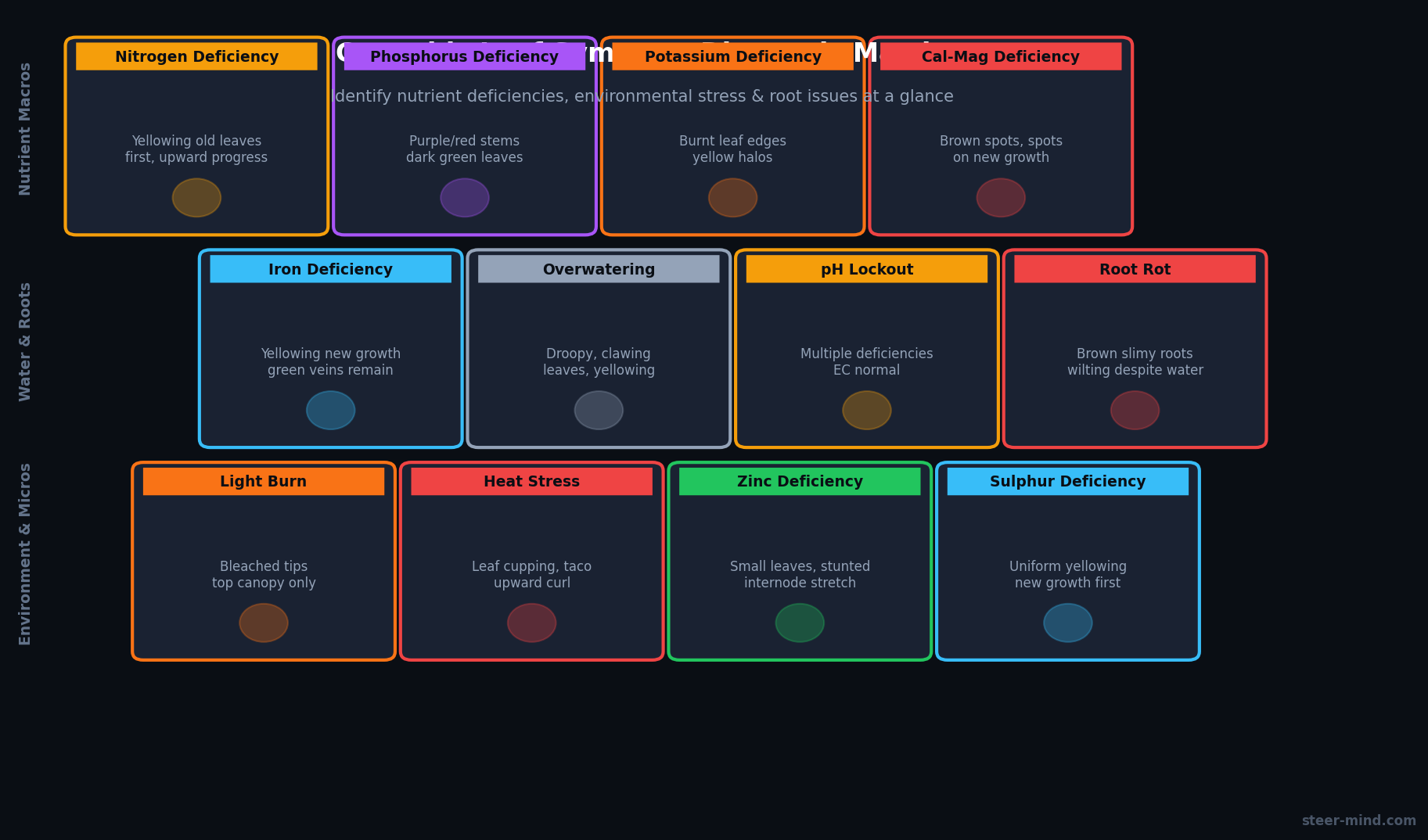
Why Nutrient Deficiencies Matter
Cannabis is a vigorous, fast-growing plant with high nutritional demands. During a single flowering cycle, a healthy plant may increase its dry mass by 200-400%, requiring a precisely balanced supply of macro- and micronutrients at every stage. When even one element falls short, the plant's metabolism is disrupted — photosynthesis slows, enzyme systems stall, and structural integrity weakens.
Deficiency symptoms are the plant's distress signals, and they follow predictable patterns based on nutrient mobility. Recognizing these patterns early is the difference between a minor correction and a catastrophic yield loss. Studies on controlled-environment cannabis cultivation show that uncorrected nitrogen deficiency during weeks 3-5 of flowering can reduce final yield by up to 30%, while calcium deficiency during the same window increases susceptibility to bud rot by destabilizing cell walls.
Crucially, most deficiency symptoms that growers encounter are not caused by a lack of nutrients in the feed solution. Instead, they result from pH drift, salt accumulation, or antagonistic interactions that lock out specific elements. A systematic diagnostic approach — checking pH first, then EC, then individual nutrient ratios — prevents the common mistake of adding more fertilizer to a lockout problem, which only makes things worse.
Macronutrients: Nitrogen, Phosphorus, Potassium
The three primary macronutrients — nitrogen (N), phosphorus (P), and potassium (K) — are consumed in the largest quantities and are all mobile within the plant. This means deficiency symptoms always appear on older, lower leaves first, because the plant strips these elements from mature tissue and shuttles them to actively growing shoots and flowers.
Nitrogen (N)
Nitrogen is the backbone of amino acids, chlorophyll, and nucleic acids. It is the nutrient most directly tied to vegetative growth rate and leaf color. Cannabis requires the highest nitrogen supply during the vegetative phase (N-P-K ratios around 3-1-2) and a reduced but still significant amount during early to mid-flower.
- Early symptoms: Uniform pale green to yellow coloring starting at the lowest leaf pairs, progressing upward over days. Leaves do not develop spots — the fading is even across the entire blade.
- Advanced symptoms: Lower leaves turn completely yellow, then brown, and drop off. Growth rate slows noticeably. Stems may develop a purple or reddish hue due to increased anthocyanin expression.
- Correction: Increase nitrogen in the feed. In hydro/coco, raise EC by 0.1-0.2 mS/cm using a grow-phase nutrient or add calcium nitrate. Ensure pH is 5.8-6.2 for optimal N uptake. Response is visible in new growth within 4-7 days.
Phosphorus (P)
Phosphorus plays a central role in energy transfer (ATP), root development, and flower formation. Demand spikes sharply during the transition to flowering and remains high through mid-bloom. Cannabis is moderately efficient at scavenging phosphorus, so acute deficiency typically indicates a severe lockout or a critically undersized feed.
- Early symptoms: Older leaves develop a dark, bluish-green color. Leaf tips and edges may turn brown or bronze. Petioles and stems sometimes show purple streaking.
- Advanced symptoms: Leaves curl downward and develop dark necrotic patches. Flower development stalls — buds remain small and airy. Root growth slows dramatically.
- Correction: Verify pH first — phosphorus becomes unavailable below 5.5 and above 7.0. Add a bloom booster or mono-phosphate supplement. Avoid over-correcting: excess phosphorus locks out zinc, iron, and calcium.
Potassium (K)
Potassium regulates stomatal function, water balance, and the transport of sugars from leaves to flowers. It is critical for flower density and resin production. Cannabis demand for potassium is highest during weeks 4-7 of flowering.
- Early symptoms: Brown, crispy edges on older leaves (marginal necrosis). Leaves may appear dull and slightly curled. Interveinal areas remain green initially.
- Advanced symptoms: Necrosis spreads inward from leaf margins. Leaves become brittle and crumble easily. Flower development slows, and buds lack density.
- Correction: Increase potassium via potassium sulfate or a bloom-phase nutrient. Check that the Ca:K ratio stays above 2:1 to avoid calcium antagonism. Optimal pH for K uptake is 5.8-6.5.
Secondary Nutrients: Calcium, Magnesium, Sulfur
Secondary nutrients are required in smaller quantities than N-P-K but are equally essential for healthy growth. Calcium and magnesium deficiencies are among the most common problems in indoor cannabis cultivation, particularly when using reverse-osmosis water or coco coir substrates.
Calcium (Ca) — Immobile
Calcium is a structural component of cell walls and membranes. It cannot be redistributed within the plant, so deficiency symptoms always appear on the newest growth first. Cannabis has a high calcium demand relative to most crops, especially under intense lighting where transpiration rates are elevated.
- Early symptoms: Irregular brown or rust-colored spots on newer leaves, often concentrated between the veins. New growth may appear distorted or crinkled.
- Advanced symptoms: Necrotic leaf margins on upper growth. Growing tips die back. Stems become weak and hollow. Bud sites abort or develop poorly.
- Correction: Supplement with CalMag at 1-2 ml/L. Ensure pH is above 5.8 — calcium uptake drops sharply below this threshold. Maintain a Ca:Mg ratio of 3:1 to 5:1. Promote adequate transpiration (VPD 0.8-1.4 kPa) since calcium travels exclusively via the transpiration stream.
Magnesium (Mg) — Mobile
Magnesium sits at the center of every chlorophyll molecule and is essential for photosynthesis and enzyme activation. As a mobile nutrient, deficiency appears on older leaves first. Coco coir naturally binds magnesium cations, making supplementation necessary in virtually all coco-based grows.
- Early symptoms: Interveinal chlorosis on older, lower leaves — the tissue between veins turns yellow while veins remain green, creating a characteristic striped pattern.
- Advanced symptoms: Yellowing spreads upward through the canopy. Affected leaves develop rust-colored spots and curl upward at the edges. Severe deficiency causes premature leaf drop.
- Correction: Add CalMag or Epsom salt (magnesium sulfate) at 1-2 g/L. Foliar spray with 1-2% Epsom salt solution provides faster relief (visible within 2-3 days). Ensure potassium is not excessive, as K and Mg compete for uptake.
Sulfur (S) — Semi-mobile
Sulfur is a component of amino acids (cysteine and methionine), vitamins, and several coenzymes. It plays a role in terpene and essential oil production. Sulfur deficiency is relatively rare in cannabis because most nutrient lines and water sources contain adequate amounts, but it can occur with heavily filtered water or during intense flowering.
- Early symptoms: Uniform yellowing of newer leaves — similar to nitrogen deficiency but affecting the top of the plant rather than the bottom. Leaves may feel slightly stiff.
- Advanced symptoms: Growth slows across the entire plant. Stems become woody and thin. Buds produce fewer trichomes and weaker aroma, as terpene synthesis depends on sulfur-containing precursors.
- Correction: Add Epsom salt (magnesium sulfate) or potassium sulfate. Most CalMag products also contain sulfur. Ensure pH is within the 5.8-6.5 range. Symptoms improve in new growth within 5-7 days.
Micronutrients: Fe, Mn, Zn, B, Cu, Mo
Micronutrients are required in trace amounts but are no less critical. A deficiency in any single micronutrient can bottleneck the plant's entire metabolism. Most micronutrient issues in cannabis stem from pH-induced lockout rather than absence from the nutrient solution — particularly iron, manganese, and zinc, which become unavailable above pH 6.5 in soilless media.
| Nutrient | Mobility | Key Function | Deficiency Symptoms | Correction |
|---|---|---|---|---|
| Iron (Fe) | Immobile | Chlorophyll synthesis, electron transport | Interveinal chlorosis on newest leaves — bright yellow tissue with sharply contrasting green veins. Leaves may turn almost white in severe cases. | Lower pH to 5.8-6.0. Apply chelated iron (Fe-DTPA or Fe-EDDHA). Foliar spray with 0.1% chelated iron for rapid response. |
| Manganese (Mn) | Immobile | Photosystem II, enzyme activation | Interveinal chlorosis on younger leaves with small tan or brown necrotic spots scattered across the blade. Similar to iron but with speckling. | Correct pH to 5.8-6.2. Apply manganese sulfate. Avoid excessive iron supplementation, which can antagonize Mn. |
| Zinc (Zn) | Immobile | Auxin production, internode elongation | New leaves emerge small and narrow with shortened internodes (rosetting). Interveinal chlorosis with a bronze or mottled appearance. | Lower pH if above 6.5. Apply zinc sulfate or chelated zinc. Reduce phosphorus if excessively high, as P locks out Zn. |
| Boron (B) | Immobile | Cell wall formation, sugar transport, pollen viability | Hollow or rough stems. Growing tips die back or become twisted. Root tips brown and stop elongating. Upper leaves thicken and become brittle. | Apply borax or boric acid at very low doses (0.25-0.5 ppm B). Boron toxicity occurs at only slightly higher concentrations — use caution. |
| Copper (Cu) | Immobile | Lignin synthesis, enzyme cofactor | Young leaves wilt and curl downward with dark blue-green coloring. Leaf tips turn white or bleached. Stems become weak and floppy. | Apply copper sulfate at trace levels. Ensure pH is below 6.5. Copper toxicity is very damaging — never exceed recommended doses. |
| Molybdenum (Mo) | Mobile | Nitrate reductase (converts nitrate to ammonium) | Older leaves develop marginal scorching and interveinal chlorosis resembling nitrogen deficiency. Leaves may cup upward and develop an orange or pinkish tint. | Raise pH slightly if below 5.5 — Mo availability increases with pH. Apply sodium molybdate at trace concentrations. |
Complete Deficiency Overview Table
This reference table consolidates all essential nutrients with their mobility, the earliest visible symptoms, the part of the plant affected first, and a quick corrective action. Use it as your first diagnostic step when symptoms appear.
| Nutrient | Mobile / Immobile | First Symptoms | Affected Area | Quick Fix |
|---|---|---|---|---|
| Nitrogen (N) | Mobile | Uniform yellowing of entire leaves | Older, lower leaves | Increase N in feed; raise EC by 0.1-0.2 |
| Phosphorus (P) | Mobile | Dark blue-green leaves, purple stems | Older, lower leaves | Check pH (5.5-6.5); add bloom booster |
| Potassium (K) | Mobile | Brown, crispy leaf margins | Older, lower leaves | Add K sulfate; check Ca:K ratio |
| Calcium (Ca) | Immobile | Brown spots on new growth, distorted tips | Newest leaves, shoot tips | CalMag 1-2 ml/L; pH above 5.8 |
| Magnesium (Mg) | Mobile | Interveinal chlorosis (yellow between green veins) | Older, lower leaves | Epsom salt 1-2 g/L or CalMag |
| Sulfur (S) | Semi-mobile | Uniform yellowing of new leaves (like N but on top) | Newer leaves | Epsom salt or K sulfate; check pH |
| Iron (Fe) | Immobile | Bright yellow new leaves with green veins | Newest leaves | Lower pH to 5.8-6.0; chelated iron |
| Manganese (Mn) | Immobile | Interveinal chlorosis with tan speckles | Younger leaves | Correct pH to 5.8-6.2; Mn sulfate |
| Zinc (Zn) | Immobile | Small, narrow new leaves; rosetting | New growth, shoot tips | Lower pH; reduce excess P; chelated Zn |
| Boron (B) | Immobile | Hollow stems, twisted new growth | Growing tips, stems | Borax at very low dose (0.25-0.5 ppm) |
| Copper (Cu) | Immobile | Wilting new leaves with dark blue-green color | Youngest leaves | Trace Cu sulfate; pH below 6.5 |
| Molybdenum (Mo) | Mobile | Marginal scorch resembling N deficiency | Older leaves | Raise pH above 5.5; sodium molybdate |
Deficiency vs. Excess: How to Distinguish
One of the most critical diagnostic skills is distinguishing a genuine nutrient deficiency from nutrient excess (toxicity). Both can produce alarming visual symptoms, and the corrective actions are opposite — adding nutrients to an excess problem accelerates damage, while flushing during a true deficiency worsens the shortage. Misdiagnosis at this stage is the single most common reason growers spiral into compounding issues.
The most reliable method is measuring the runoff EC relative to your input EC. If the runoff EC is significantly higher than the input (delta above 0.5 mS/cm), salts are accumulating in the substrate and the problem is more likely a lockout or toxicity. If the runoff EC is at or below the input, the plant is consuming nutrients faster than they are being supplied, pointing toward a genuine deficiency.
Key Indicators of Excess (Toxicity)
- Nitrogen toxicity: Very dark, glossy green leaves that claw downward. Leaf tips curl under like talons. Slowed flowering and reduced bud density.
- Phosphorus toxicity: Rarely shows direct leaf symptoms. Instead, it locks out zinc, iron, and calcium — producing symptoms that mimic those deficiencies.
- Potassium toxicity: Causes calcium and magnesium lockout. Leaves show interveinal chlorosis and brown spotting on newer growth despite adequate Ca/Mg in the solution.
- Micronutrient toxicity: Boron and copper toxicity appear as yellow or necrotic leaf tips with dark spots. Iron toxicity causes bronzing of leaves. These are serious because the margin between sufficiency and toxicity is narrow for trace elements.
When in doubt, measure first and act second. A pH and EC reading of both the input solution and the runoff takes less than two minutes and eliminates most guesswork. If your runoff pH has drifted below 5.5 or above 6.8, correcting the pH alone — without adding any nutrients — will often resolve the visible symptoms within days.
Step-by-Step Correction Workflow
When deficiency symptoms appear, follow this systematic protocol to diagnose the root cause and apply the correct fix without making things worse.
-
Measure runoff pH and EC.
Water the plant with your normal nutrient solution and collect the runoff. Measure both pH and EC. Record the input values and the runoff values. Calculate the delta EC (runoff minus input).
-
Evaluate the pH range.
If the runoff pH is below 5.5 or above 6.8 (soilless) or below 6.0 or above 7.2 (soil), pH correction is your first priority. Adjust the input pH to bring the runoff back into the optimal range over 2-3 waterings. Do not add extra nutrients yet.
-
Assess the EC delta.
If the delta EC is above 0.5 mS/cm, salts are accumulating. Increase the drain fraction to 25-30% for the next 2-3 waterings. If the delta exceeds 1.0, perform a targeted flush with a quarter-strength nutrient solution at the correct pH.
-
Identify the deficient nutrient.
With pH and EC stabilized, use the overview table above to match the symptom pattern (location, color, pattern) to the specific nutrient. Note whether the affected area is older or newer growth to determine mobility.
-
Apply a targeted correction.
Add the specific nutrient at a conservative dose. For macronutrients, increase the relevant component by 10-20%. For micronutrients, use a chelated supplement at the manufacturer's recommended rate. Avoid the temptation to add everything at once.
-
Monitor and document.
Photograph the affected leaves for comparison. Check new growth daily. Damaged tissue will not recover — success is measured by symptom-free new leaves and shoots appearing within 5-7 days. If symptoms continue to spread after one week, re-evaluate from step one.
Frequently Asked Questions
How do I tell which nutrient my cannabis plant is lacking?
Start by noting where symptoms appear first. Mobile nutrients like nitrogen, phosphorus, and potassium show deficiency on older, lower leaves because the plant redistributes them to new growth. Immobile nutrients like calcium, iron, and manganese show symptoms on newer, upper growth because the plant cannot move them from older tissue.
Next, examine the symptom type: uniform yellowing suggests nitrogen or sulfur; interveinal chlorosis points to magnesium or iron; brown spots indicate calcium or manganese; crispy margins indicate potassium. Cross-reference with the overview table for confirmation.
What is the most common nutrient deficiency in cannabis?
Nitrogen deficiency is the most frequently encountered issue, especially during the vegetative phase when demand is highest. It presents as uniform yellowing starting from the lowest leaves and progressing upward.
However, many apparent deficiencies are actually caused by incorrect pH rather than a lack of nutrients in the solution. Calcium and magnesium deficiency rank second and third, particularly in coco coir grows where the substrate naturally binds these cations.
Can overwatering cause symptoms that look like nutrient deficiency?
Yes. Overwatering reduces oxygen in the root zone, impairing nutrient uptake even when the solution contains adequate minerals. Symptoms of overwatering — drooping leaves, slow growth, yellowing — closely mimic nitrogen or iron deficiency.
Always check watering practices and root health before adding more nutrients. Lift the pot to gauge weight, and ensure at least 15-20% drain fraction to maintain proper oxygen levels in the root zone.
Should I flush my medium when I see deficiency symptoms?
Not immediately. Flushing removes nutrients from the substrate and can worsen a true deficiency. First, measure runoff pH and EC to determine whether the problem is a lockout (wrong pH or salt buildup) or an actual shortage.
If runoff EC is very high with a large delta, a light flush followed by a corrected nutrient solution is appropriate. If EC is normal or low, adjust pH or increase the specific nutrient instead. Blind flushing without data is one of the most common mistakes in cannabis cultivation.
How long does it take for deficiency symptoms to improve after correction?
Most mobile nutrient deficiencies (N, P, K, Mg) show improvement in new growth within 5 to 7 days after correction. Immobile nutrient deficiencies (Ca, Fe, Mn) stop spreading to new leaves within 3 to 5 days.
Already damaged tissue will not recover in either case — success is measured by healthy new growth appearing symptom-free. If symptoms continue to worsen after 7 days, re-evaluate pH, EC, and watering practices from the start.