Diagnosis
Cannabis Root Rot and Pythium: Causes, Identification, and Recovery
Pythium root rot is the most common catastrophe in hydro and hydroponic systems. It progresses rapidly, but with the right understanding of root causes and immediate intervention, you can stop it.
The Science Behind Pythium
Pythium spp. are oomycetes (water molds), not true fungi. Key species in cannabis cultivation are Pythium ultimum and P. aphanidermatum. They are obligate water pathogens requiring permanent saturation or extreme moisture.
Life Cycle and Optimal Conditions
Pythium sporangia germinate at >22°C water temperature and low oxygen. Zoospores swim to roots, penetrate the epidermis, and colonize cortex tissue. Lethal conditions: below 15°C or above 30°C, high oxygen concentration, pH below 5.0 (Pythium prefers pH 6.5+).
Critical: Pythium is not a true fungus and resists chitin-targeting fungicides completely. A standard botrytis fungicide is useless against Pythium!
| Water Temperature | Pythium Risk | Spore Germination |
|---|---|---|
| <15°C | Minimal | None |
| 15–20°C | Low | Very slow |
| 20–22°C | Moderate | Germination begins |
| 22–28°C | High | Exponential |
| >30°C | Low (heat stress) | Suppressed |
Symptoms and Diagnosis
Root rot symptoms appear surprisingly fast, often within 3–7 days of infection onset.
Above-Ground Symptoms
- Wilting with wet substrate: The signature sign! Leaves droop despite wet soil/solution. Unlike overwatering, the plant doesn't recover after watering.
- Yellowing and leaf discoloration: Lower leaves turn yellow, no green veining visible (resembles nitrogen deficiency but sudden onset).
- Collapse: In severe cases, within hours. Plant looks scorched.
- Growth stall: New leaves don't grow, shoots remain stunted.
Root Diagnosis
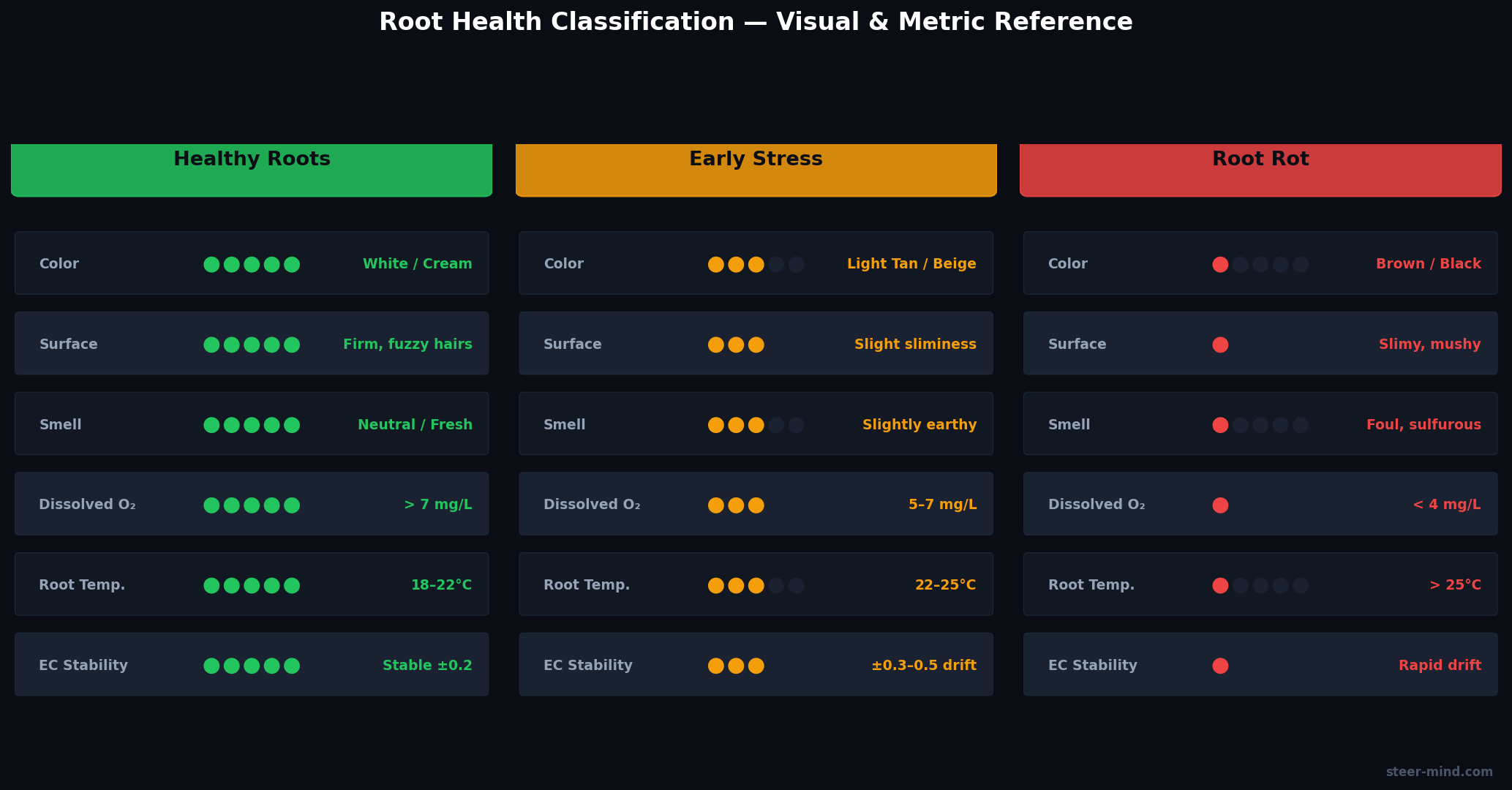
Pulled roots show classic signs:
- Discoloration: Brown to black instead of white. Root cortex is brittle, core may be visible.
- Slimy coating: Mucilaginous decomposition. Roots smell foul/musty.
- Lack of root hairs: Secondary roots completely absent—Pythium preferentially destroys them.
Practice tip: In DWC systems, if you see wilting, pull a root immediately and inspect—white = OK, brown/black = Pythium active. No time to waste!
Common Causes
Nutrient Solution Temperature Above 22°C
The most common trigger. In summer NFT or DWC systems without chillers, solution can reach 24–28°C. Pythium optimizes at 25–27°C. Fix: Chiller, ice chamber, or cold water changes.
Oxygen Deficiency in Root Zone
DWC without air stone, stopped aquarium pump, clogged NFT lines = anaerobic conditions = Pythium thrives. Hydroguard or oxygen boosting (powerful air stone) is essential.
Substrate Problems (Coco/Soil)
- Overly moist, dense substrate: Peat, clay-based, or coco without perlite/vermiculite promotes waterlogging.
- Poor or no drainage: Pots without drain holes or clogged drainage openings.
- Cross-contamination: Reused infected substrates, non-disinfected tools.
Sanitation Failures
Pythium spores survive on tools, in old nutrient solution remnants, and container surfaces. One contaminated water tank can destroy an entire system.
Treatment and Recovery
Emergency Measures (First 24 Hours)
- H₂O₂ shock: 3% hydrogen peroxide, 1–2 mL/L into nutrient solution. Acts as oxidizer against anaerobic conditions and kills Pythium zoospores directly. Use sparingly: max 2x in 48h due to root damage potential.
- Drain and refill: In DWC/NFT, immediately empty tank, disinfect it (100 ppm chlorine water, 10 min), and refill with fresh solution.
- Temperature reduction (immediate): Target <20°C. Run chiller, submerge ice chamber, or dilute with cold water.
- Maximize aeration: Air stones to full strength, add oxygen stone, or run continuous circulation (NFT only, not DWC standing).
Follow-Up Treatment (Days 2–14)
Bacillus subtilis or Trichoderma harzianum: Beneficial bacteria and fungi outcompete Pythium and produce antifungal compounds. Commercial product: Hydroguard (Bacillus amyloliquefaciens). Dosage: 5 mL per 10L. Apply daily until roots are white again.
pH adjustment: Lower pH to 5.8–6.0 in DWC/NFT. Acidic pH is unfavorable for Pythium.
Nutrient solution changes every 5–7 days: Fresh solution without Pythium spores. New tank pre-disinfected.
Pythium Biology: How the Oomycete Colonizes Roots
Pythium is a biologically fascinating pathogen, and understanding its mechanisms is the key to effective control. Unlike true fungi (Fungi), Pythium belongs to the oomycetes (water molds), a distinct organismal group with fundamental differences in cell wall structure and reproductive strategies.
Why Pythium is Not a True Fungus
True fungi have cell walls made of chitin (the same material that builds insect exoskeletons). Pythium cell walls are made of cellulose and β-glucan—the same compounds that build plant cell walls. This has critical consequences: standard fungicides that target chitin are utterly useless against Pythium. Applying a botrytis fungicide to Pythium is like pouring water on a stone.
Genetic evidence reveals the truth: oomycetes are evolutionarily closer to algae and aquatic plants than to true fungi. They are aquatic in their biology and require permanent water or extremely high humidity to thrive.
Zoospores: The Infection Vehicle
Pythium sporangia produce motile zoospores—club-shaped spores with two flagella that actively navigate through water like tiny swimmers. This is a critical difference from true fungal spores, which drift passively through air.
- Zoospore release: At water temperatures above 22°C and low oxygen (hypoxic conditions), sporangia open and release thousands of zoospores per root contact.
- Chemotaxis: Zoospores are chemically attracted to roots—they "smell" sugars and amino acids diffusing from root tips. The spore actively swims toward them.
- Penetration: The zoospore encypts (becomes a resting form), adheres to the root epidermis, and drills through the cell wall. Within 1–2 hours, the pathogen is inside cortex tissue.
- Colonization: In the cortex, Pythium becomes a vegetative form (hyphae), enzymatically digests cell walls, and destroys cell membranes. Infection spreads exponentially.
Practical implication: Because zoospores swim and respond to chemical signals, moving water (like in NFT) is more dangerous than stagnant water (DWC)—provided DWC is well-aerated. Stagnant nutrient solution = zoospore hotbed.
Temperature Dependence and Physiology
Pythium shows a clear thermal curve. The optimum lies at 25–27°C—exactly where many cannabis growers without temperature control end up landing.
| Temperature Range | Pythium Activity | Sporangia Production | Practical Meaning |
|---|---|---|---|
| <12°C | Dormant | None | Winter water storage safe |
| 12–18°C | Minimal | Very slow | Below-optimum; dormancy preferred |
| 18–22°C | Low | Germination starts | Marginal risk; prevention warranted |
| 22–26°C | Very high | Exponential | CRITICAL ZONE – Chiller absolutely essential |
| 26–30°C | Maximal | Highest rate | Infected plants can collapse in 48 hours |
| >30°C | Drops rapidly | Temperature inhibition | Heat stress on plant, Pythium suppressed |
Transmission Vectors in Practice
Pythium is already everywhere—in natural water sources, soil, rainwater. Transmission into the grow occurs through several vectors:
- Contaminated water: Rainwater, well water, or tap water may carry Pythium spores. A single contaminated water tank infects the entire system.
- Substrate transfer: Used coco, soil, or hydroton can harbor sporangia for months. Reused substrate = highest risk.
- Tools and hands: Pythium spores stick to knives, potting shovels, gloves. One touch in an infected pot, then the next = infection chain.
- Insect vectors: Fungus gnats (Sciaridae) and soil flies (Mycetophilidae) can carry sporangia in their digestive tracts and spread them plant-to-plant. Small but often-overlooked source.
- High-humidity aerosols: In very humid rooms (>85% RH), zoospore-laden water droplets can land on leaf surfaces and drip to roots. Rare as direct infection, but possible.
Critical: Pythium survives dry conditions poorly. Dried, stored substrate is practically clean. Wet, poorly stored substrate is a pathogen incubator.
Treatment Protocol: H₂O₂, Hydroguard, and Biocontrol Agents
Effective Pythium treatment is not a single-shot affair but a coordinated protocol. Each agent has a role; timing and dosage determine success or failure.
Mechanisms of Action and Agent Selection
Success is built on a three-pillar strategy: (1) immediate pathogen suppression, (2) promotion of antagonists, and (3) environmental optimization against Pythium.
| Agent | Concentration | Application | Contact Time | Repeat | Notes |
|---|---|---|---|---|---|
| H₂O₂ 3% | 1–2 mL/L | Add to nutrient solution, mix thoroughly | 30 min – 2 hours | Max 2x in 48h (root damage risk) | Immediate oxidizer; kills zoospores but damages root hairs. Emergency-only. Do not overuse. |
| Bacillus subtilis (Hydroguard) | 5 mL per 10L (or per label) | Daily in solution or watering water | 3–5 days colonization | Daily until roots are white (usually 10–21 days) | Best long-term strategy. Bacillus produces lipopeptides that destroy Pythium cell walls. Synergistic with H₂O₂. |
| Copper Sulfate (CuSO₄) | 2–5 mg/L (dose carefully!) | Weekly to solution or as foliar spray | Continuous | Weekly; avoid accumulation | Time-tested fungicide. Cu ions inhibit Pythium but are also toxic to cannabis roots above 10 mg/L. Minimal dosing; don't overdose out of fear. |
| Neem Oil | 5–10 mL/L | Foliar spray (NOT in solution) or soil drench | 3–7 days | Every 3–5 days during active infection | Azadirachtin inhibits Pythium sporulation. Also helps with thrips and mites. Can irritate leaves at high concentration. |
| Great White (Mycorrhizae Mix) | 1 tsp per pot or 2 mL per 10L solution | Mix into substrate before potting OR add to reservoir post-infection | 2–3 weeks (colonization) | Once, or weekly as prophylaxis | Arbuscular mycorrhizae (AMF) and Bacillus form symbiosis with roots. Valuable for prevention. NOT during active infection crisis, use in recovery phase. |
| Trichoderma harzianum | 5–10⁷ CFU/mL (commercial: per label) | Weekly to solution or soil drench | 5–7 days colonization | Weekly during recovery; monthly as prophylaxis | Fungal antagonist; suppresses Pythium via mycoparasitism and chemical inhibition. Complements Bacillus. |
| Chlorine (Sodium Hypochlorite) | 20–100 ppm (0.002–0.01% solution) | Prophylactically in solution; or tank disinfection: 200 ppm × 15 min | Continuous (at 20 ppm prophylactically); 15 min for disinfection | Daily prophylactically; NOT as primary treatment | Strongly oxidizing; non-selective. Kills Pythium AND Bacillus/Trichoderma! Use chlorine EITHER prophylactically OR with biocontrols, not both intensively. Incompatible with biological control. |
Three-Stage Treatment Schema
Agents must not be combined haphazardly. Structured application dramatically increases success:
- Stage 1 – Shock and Changeover (Hours 0–24): H₂O₂ shock (1–2 mL/L for 30–60 min). Simultaneously or immediately after: complete nutrient solution change. Empty old tank, disinfect with 200 ppm chlorine water (10 min), dry, and refill. Drop water temperature to <18°C.
- Stage 2 – Colonization (Days 1–7): Daily Bacillus subtilis (Hydroguard) 5 mL per 10L. Optional: Trichoderma as supplementary antagonist. NO CHLORINE! Bacillus spores need space and nutrients to germinate. Water change on days 3–5 if symptoms persist.
- Stage 3 – Stabilization (Days 7–21): Continue daily Bacillus. After day 7: add Great White (mycorrhizae) for long-term root resilience. Weekly 30–50% water changes. By day 14, observe: are roots white and bushy again? Transition to prophylaxis protocol.
Dosing Pitfalls and Specifics
Beginners make frequent dosing mistakes. Here are critical points:
- H₂O₂ overdose: Some growers pour 5–10 mL of 3% H₂O₂ per liter "to be safe." This is catastrophic—it destroys not just Pythium but beneficial bacteria and root hairs. Stick to 1–2 mL/L and wait.
- Bacillus-chlorine conflict: Major error: full-strength H₂O₂ + Bacillus the same day. The oxidizer kills Bacillus spores before they germinate. Timing: H₂O₂ in morning (2h contact), Bacillus in evening or next day.
- Copper accumulation: Copper sulfate builds up in coco and soil. After 3–4 weeks, concentration can become toxic to cannabis (Cu toxicity = red/orange discoloration, growth stall). Don't dose weekly "to be safe"!
- Great White too early: Mycorrhizae help healthy roots. They cannot colonize rotting roots. Add Great White only after day 7, when roots recover and new root hairs form.
Systemic Prevention: Substrate, Water Temperature, and Hygiene Protocol
The best treatment is prevention. After a single Pythium episode, growers typically invest in prevention infrastructure to avoid recurrence. Here is a detailed prevention regime:
- Keep water temperature below 22°C before use: All water sources (rainwater, well, tap) should be tempered before entering the system. A simple chiller or passive cooling (tank in shade, water standing overnight) is standard. Measure temperature daily with a thermometer—above 22°C = alarm.
- Use prophylactic H₂O₂: Weak prophylactic dose: 0.5 mL 3% H₂O₂ per liter, 1–2x weekly (NOT daily!). This prevents zoospore blooms without damaging roots at this dilution. Alternatively: chlorine 20–30 ppm weekly as weak prophylaxis.
- Never reuse substrate: Single-use policy for coco, soil, and hydroton. Dispose of old substrates. The $10 savings on coco is not worth the Pythium risk. If reuse is absolutely unavoidable: saturate substrate for 24 hours with 200 ppm chlorine water, then expose to sun or oven (80°C, 20 min). This is labor-intensive—buy new.
- Keep nutrient solution fresh daily: NFT and DWC lose water daily (evaporation + uptake). Some growers top off with tap water. Major mistake—pathogens concentrate. Better: weekly 30–50% changes with fresh solution. DWC tanks lose water, salt concentrates = higher Pythium risk.
- UV sterilizer in recirculating systems: Recirculating NFT, ebb/flow, or even indoor DWC can benefit from a UV-C sterilizer. 6–11 watts UV-C per 100L throughput destroys 99.9% of zoospores. Entry cost ~$150; long-term investment for serious growers.
- Full disinfection between runs: Complete sanitation after each crop (before next starts): flush all tubing and tanks with 200 ppm chlorine water (15 min contact), then rinse thoroughly 3x with fresh water. Discard or autoclave air stones. Old pots and containers also disinfected. Time-consuming but prevents total losses.
Substrate-Specific Prevention
DWC systems: Critical is daily temperature monitoring. Water below 20°C + good aeration (minimum 4 air stones per 100L, 24h) = Pythium risk <5%. Additionally, weekly Bacillus (5 mL per 10L, even without infection) as immune-boosting measure.
Coco cultivation: 60% coco, 30% perlite, 10% worm compost. Never pure coco! Perlite creates air pores even when coco is saturated. Dry-back cycles are critical: after watering, top dries out, bottom stays moist for 24 hours. This reduces Pythium sporulation by ~70%. Water with 0.5 mL H₂O₂ per liter as preventive.
Soil/peat mixes: Loose blend is key. 40% peatmoss, 30% perlite, 20% coconut fiber, 10% worm compost. Cold watering water (not warm). In rooms above 24°C, increase ventilation further.
Detailed Hygiene Protocol
Contamination comes from outside. Cleanliness fanaticism pays off:
- Tools: After each pot work (potting, moving, harvesting), wipe with 70% ethanol or 200 ppm chlorine water. Wet soil sticks—wash, dry, disinfect.
- Gloves: Separate gloves for each area (propagation, veg, flower). Change after wet substrate contact.
- Water tanks: Monthly scrub with brush, remove biofilm, disinfect with 100 ppm chlorine for 10 min, rinse thoroughly. Keep lids closed (blocks insects, dust).
- Air stones and pumps: After 2–3 weeks, black biofilm (= pathogen hotbed) builds. Swap air stones every 2–3 weeks or autoclave them. Disassemble and clean pumps monthly.
- Pest control: Fungus gnats and soil flies are Pythium vectors. Use sticky traps, release predatory nematodes (Stratiolaelaps scimitus) on infestation. A gnat population can seed infections in adjacent systems.
DWC/Hydro Systems
- Water cooling: Keep water temperature permanently below 20°C. Chillers are standard in the US, often neglected in Europe—major mistake!
- Aeration: Large aquarium air stones (4–6 per 100L), running continuously 24h.
- UV sterilization: UV-C light in recirculating systems destroys Pythium zoospores (optional but recommended).
- Weekly water changes: Older water has higher pathogen load—change 30–50% weekly.
Coco Substrates
- Good drainage ratio: 60% coco, 30% perlite, 10% compost or similar. Don't compress too tightly.
- Dry-back cycles: Don't water daily. Let substrate slightly dry between waterings (top dry, bottom moist). Lowers Pythium pressure.
- Bacillus inoculation: Add beneficial bacteria to coco mix before potting, or as watering solution additive.
Soil/Loam Mixes
- Airy blend: 40% peatmoss, 30% perlite, 20% coconut fiber, 10% worm compost. Never compacted peat alone.
- No wet substrate storage: Keep growing media in a dry room. Wet substrate can harbor Pythium.
- Water quality: Cold water (not warm), or add Bacillus at first watering.
Prevent Cross-Contamination
- Disinfect all tools after contact with wet substrate (70% ethanol or 200 ppm chlorine).
- Discard old substrates—don't reuse.
- Rinse water tanks regularly with chlorine water (100 ppm, 15 min) and dry completely.
- Separate new clone generation physically (prevents cross-infection).
Frequently Asked Questions
Can I save infected plants?
Yes, in early stages (roots still partially white). Water change + H₂O₂ shock + Bacillus addition + temperature reduction. Earlier detection = better odds. Advanced stages (50%+ brown roots) usually result in total loss.
What's the difference from Fusarium?
Pythium: water pathogen, rapid (3–7 days), wilting above ground. Fusarium: soil fungus, slower (2–3 weeks), yellowed vein patterns, discolored vascular tissue in stem. Different treatments required.
Why doesn't standard fungicide work?
Pythium is an oomycete, not a true fungus. Its cell wall is cellulose and β-glucan, not chitin like true fungi. Standard fungicides target chitin. Only specialized treatments (Bacillus, Trichoderma, H₂O₂) are effective.
How long can Pythium survive?
Sporangia can survive 2–6 months in damp substrate or water. Pythium-contaminated solution must be discarded immediately. Substrates should be dried and disinfected (autoclaved or UV). Tubes and containers flushed with chlorine solution (200 ppm).
Does chlorine help against Pythium?
Chlorine (sodium hypochlorite, 20–100 ppm in solution) inhibits Pythium but is not a complete killer. Bacillus and H₂O₂ are more direct. Chlorine is useful as prophylaxis in recirculating systems, not as primary treatment.