Diagnosis
Spider Mites on Cannabis: Identification, Treatment, and Prevention
Spider mites are one of the most common cannabis pests. They multiply exponentially in heat and low humidity, but with the right knowledge, they can be detected early and controlled effectively without compromising your harvest.
Spider Mite Biology and Life Cycle
The two-spotted spider mite (Tetranychus urticae) is an obligate feeder that survives by piercing cell walls and consuming cell contents. It destroys mesophyll cells, leading to chloroplast collapse and tissue necrosis.
Life Cycle and Reproduction
At optimal conditions (27°C, low humidity), a spider mite develops from egg to reproductive adult in just 7–14 days. A single female lays 5–10 eggs daily. Theoretically, a starting colony of 10 mites can explode to several million in 3 weeks.
Critical factor: Temperature and VPD are the main drivers. At VPD > 1.6 kPa and 25–30°C, exponential growth occurs; below 15°C, reproduction practically stops.
| Factor | Optimal for Mites | Unfavorable for Mites |
|---|---|---|
| Temperature | 25–30°C | <15°C or >35°C |
| Humidity (RH) | <40% | >80% RH |
| Life Cycle | 7–10 days at 27°C | 30+ days at 15°C |
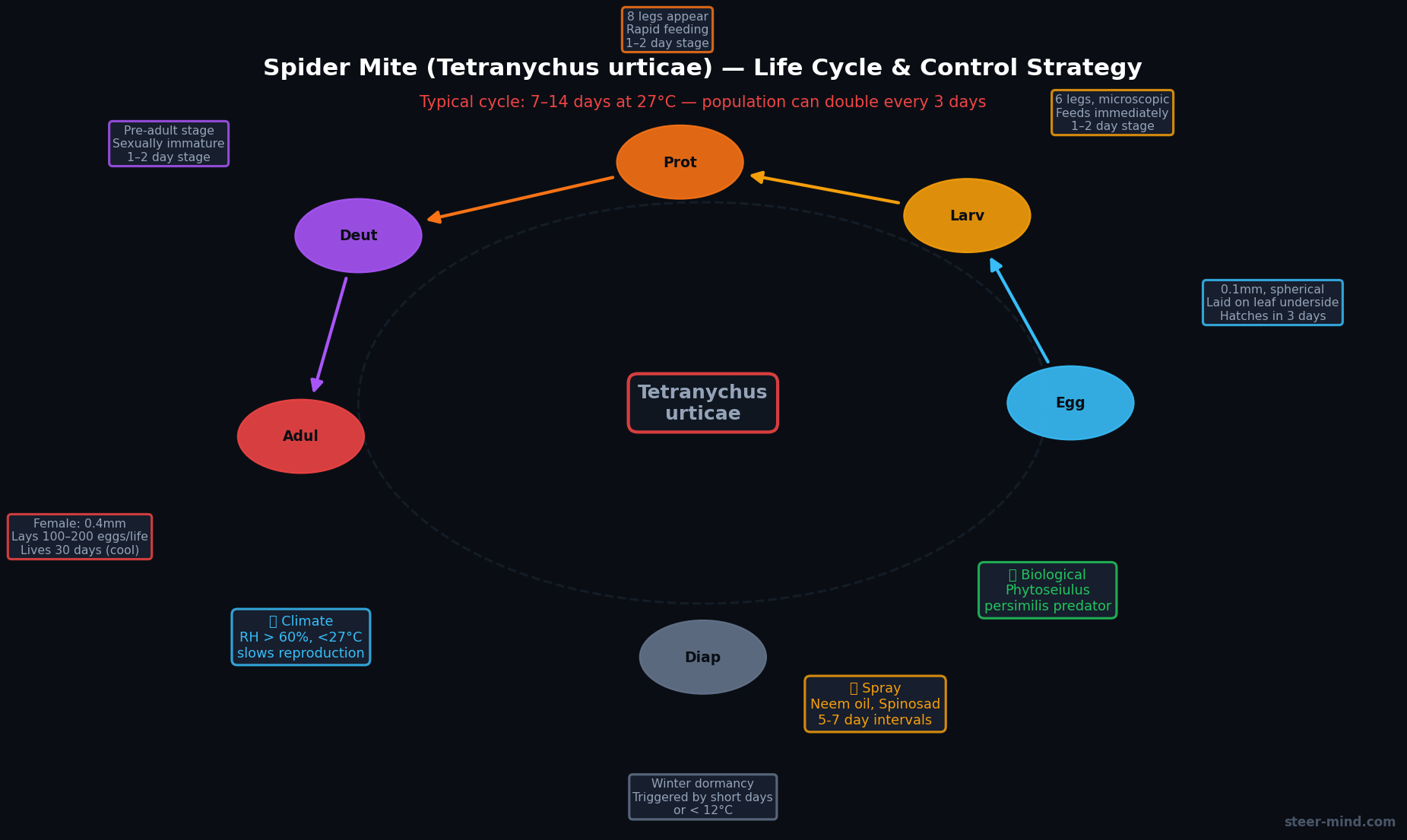
Spider Mite Lifecycle: Biology for Better Control
Understanding the spider mite lifecycle is essential to timing treatments effectively. A single missed generation can mean the difference between successful control and explosive population growth. Temperature is the master control—it determines development speed and thus the frequency with which you must repeat treatments.
The Four Life Stages
| Stage | Duration at 20°C | Duration at 30°C | Physical Characteristics | Vulnerability to Treatment |
|---|---|---|---|---|
| Egg | 7–10 days | 3–4 days | Spherical, translucent-yellowish, 0.1 mm diameter, laid in clusters on leaf undersides, sticky substrate | High (exposed, thin chorion); most insecticides kill eggs; neem has ovicidal activity |
| Larva | 3–5 days | 2 days | Smallest active stage, pale, 6 legs (not 8), very mobile, feeds immediately | High (small, fast-moving, difficult to avoid contact with pesticide) |
| Protonymph | 3–5 days | 2 days | Intermediate size, 8 legs, darker coloration, more robust | Medium (harder chitinous cuticle, some pesticide resistance genes may activate) |
| Deutonymph | 3–4 days | 1–2 days | Nearly adult-sized, fully 8-legged, pigmented, some females begin laying eggs before final molt | Medium-Low (toughest cuticle; resistant to soft-bodied insecticides; some abamectin resistance risk) |
| Adult | 20–30 days (oviparous females) | 7–10 days | 2 mm length, red or greenish, females lay 5–10 eggs daily, males do not feed (seek females) | Low (hardest stage; may have existing resistance genes; multiple treatments needed) |
Temperature Acceleration: Why Hot Rooms Explode with Mites
The lifecycle HALVES roughly for every 10°C temperature increase (Q₁₀ coefficient ≈ 2). This means:
- At 20°C: Full cycle (egg to egg-laying adult) = ~20–25 days. One generation every 3.5 weeks.
- At 25°C: Full cycle = ~14 days. One generation every 2 weeks.
- At 30°C: Full cycle = ~7–10 days. One generation every 1.5 weeks.
This acceleration has profound implications for treatment strategy. At 20°C, spraying once per week is sufficient (you're hitting each new generation as it emerges). At 30°C, you must spray every 4–5 days to break the cycle. Failure to account for temperature causes treatment failures.
Critical insight: The most common cause of spider mite treatment failure is underestimating temperature's effect on generation time. A grower who sprays every 7–10 days (standard neem/pyrethrin protocol) in a 28–30°C room is missing generations between sprays. Increase temperature control (cool to 22–24°C) to slow reproduction and reduce treatment frequency.
Webbing Function: Protection and Dispersal Highway
Spider mites produce silk webbing—a behavior that many aquaculture and laboratory researchers have studied extensively. The webbing serves multiple functions:
- Physical protection: The webbing creates a physical barrier that shields mites from contact pesticides, water spray, and predatory mites. Heavy webbing reduces spray penetration significantly.
- Humidity retention: Webbing reduces water evaporation from the microclimate beneath it, creating a humid pocket. Since spider mites prefer low humidity, this seems counterintuitive—but it protects against the plant's water-loss defense mechanism (leaf wilting).
- Dispersal highway: Mites walk along webbing to colonize new leaves. Young nymphs that have not yet reproduced use webbing as a "road" to find new feeding sites. Webbing also allows mites to catch air currents (ballooning) for long-distance dispersal.
This webbing behavior has treatment implications: sprays must penetrate webbing or damage it (surfactants and oils help break webbing). Predatory mites move through webbing more easily than heavy contact sprays, which is why biological control excels once webbing is established.
Early Detection and Diagnosis
Spider mites produce characteristic symptoms that allow early detection. The sooner you intervene, the easier control becomes.
Visual Symptoms
- Stippling: Tiny bleached dots on leaf surfaces from emptied cells. Initially scattered, later coalescing into larger necrotic patches.
- Webbing: Fine silk webbing on leaf undersides and between shoots—the most obvious tell-tale sign.
- Discoloration: Affected leaves develop a yellowish to coppery tone from pigment breakdown.
- Leaf drop: In heavy infestations, leaves drop as tissues dry out.
Practice tip: Use a 10x magnifying glass and inspect leaf undersides closely—especially on young, developing shoots. With the naked eye, mites appear as tiny red or greenish dots moving slowly.
Verification vs. Similar Symptoms
Stippling can also result from thrips or clover mites, but webbing is a reliable indicator of spider mites. Under a 20x scope, you can also identify eggs—oval, translucent-yellowish, found in clusters on leaf undersides.
Treatment Resistance: Why Mites Become Immune and What to Do
Spider mites can develop resistance to pesticides with alarming speed. Resistance has been documented in spider mites against neem, pyrethrin, sulfur, and virtually every synthetic miticide class. In California agricultural settings, abamectin-resistant populations have become dominant in just 3–5 years of heavy use. Cannabis growers face the same risk.
How Resistance Develops
Resistance arises through two main mechanisms:
- Genetic selection: In any large mite population, individuals with genetic variations conferring reduced pesticide sensitivity exist at low frequency (1 in 10,000). When you spray with a pesticide, susceptible mites die; resistant ones survive and reproduce. After 3–5 generations (3–15 weeks at warm temps), the population becomes predominantly resistant.
- Enzyme upregulation: Some mites upregulate detoxifying enzymes (cytochrome P450, glutathione S-transferase) after exposure, improving pesticide metabolism. This acquired tolerance can be inherited if genetic basis underlies the enzyme activity increase.
Repeated use of the SAME active ingredient greatly accelerates resistance development. Using abamectin twice per season in a warm room (where 4+ generations occur) nearly guarantees resistance emergence by the next season.
Active Ingredient Classes and Resistance Risk
| Active Ingredient Group | Examples | Mode of Action | Resistance Risk | Best Rotation Partner |
|---|---|---|---|---|
| Abamectins (Avermectins) | Abamectin, Milbectin | GABA-channel agonist; nerve toxin | VERY HIGH (resistance widespread) | Alternate with Mitochondrial Complex III inhibitors or Lipid biosynthesis |
| Mitochondrial Complex III | Bifenazate | Blocks electron transport in mitochondria | HIGH (moderate resistance reports) | Alternate with GABA inhibitors or Lipid biosynthesis agents |
| Lipid Biosynthesis Inhibitors | Spiromesifen, Etoxazole | Block chitin and lipid synthesis | MODERATE (emerging resistance) | Alternate with GABA inhibitors or Mitochondrial inhibitors |
| Neem Oil (Azadirachtin) | Neem products (organic) | Growth regulator + nerve disruption (multi-target) | LOW–MODERATE (multi-target = slower resistance) | Pyrethrin, Potassium soap, Predatory mites |
| Pyrethrin | Botanical pyrethroid extracts | Sodium channel disruptor | LOW–MODERATE (some cross-resistance with synthetics) | Neem, Potassium soap, Predatory mites |
| Predatory Mites | Phytoseiulus persimilis, Neoseiulus californicus | Biological (predation; no chemical mode of action) | NONE (biological control has no resistance mechanism) | N/A (primary strategy if available) |
Resistance Prevention Strategy: Mode-of-Action Rotation
The gold standard for preventing resistance is rotating between active ingredients with DIFFERENT modes of action. You do NOT rotate between abamectin and milbectin (both GABA inhibitors); that is cross-resistance. You DO rotate between abamectin (GABA) → bifenazate (Mitochondrial Complex III) → spiromesifen (Lipid synthesis) → neem (multi-target) → pyrethrin (sodium channel) and back to abamectin after 5+ weeks.
- Application 1 (Days 1–5): Abamectin (GABA inhibitor). Spray on days 1 and 3.
- Application 2 (Days 8–12): Bifenazate (Mitochondrial Complex III). Spray on days 8 and 10.
- Application 3 (Days 15–19): Spiromesifen (Lipid biosynthesis) or Neem (multi-target). Spray on days 15 and 17.
- Application 4 (Days 22–26): Pyrethrin or Potassium soap (physical/nerve disruption). Spray on days 22 and 24.
- Reset: Wait 2+ weeks before repeating abamectin. Use predatory mites concurrently if possible (they complement chemical sprays).
Maximum abamectin frequency: Never apply abamectin more than ONCE per season. Using it twice guarantees resistance emergence by next season. If you must use a hard miticide twice, use abamectin on day 1 and a completely different chemical (bifenazate) on day 15.
Predatory Mites as Resistance-Proof Control
The most sustainable long-term control is biological: predatory mite programs (Phytoseiulus persimilis, Neoseiulus californicus, Amblyseius polychromus) do not face resistance because they use predation, not a single chemical target. A predatory mite eating a spider mite is not affected by the spider mite's abamectin resistance genes. Biological control is therefore the preferred strategy for repeated or endemic infestations.
Control: Organic and Chemical
Control options depend on infestation stage, growth phase (vegetative vs. flower), and your residue tolerance.
Biological Control
Predatory mites (Phytoseiulus persimilis): Highly effective natural enemies. One female consumes up to 20 spider mites per day. They thrive at higher humidity (50–70% RH), where spider mites are less active. Application: 5–10 predatory mites per m² at early infestation.
Organic Treatments
- Neem oil (azadirachtin): Acts as ovicide and insecticide. Dosage 5–10 mL/L. Spray every 7–10 days over 3 weeks. Withdrawal: 10–14 days before harvest.
- Pyrethrin: Natural insecticide from chrysanthemum flowers. Works on nervous system. Withdrawal: 7–10 days. Fast-acting but lacks ovicidal activity—multiple applications needed.
- Potassium soap/cottonseed oil: Works by cuticle disruption. Less effective at heavy infestation but residue-free and biodegrades quickly.
Chemical Options
| Active Ingredient | Mode of Action | Resistance Risk | Safety in Flower |
|---|---|---|---|
| Abamectin | Nerve toxin (GABA channels) | High (fast resistance) | 14–21 day withdrawal |
| Milbectin (Avermectin) | Similar to abamectin | High | 14–21 day withdrawal |
| Sulfur | Cellular asphyxiation | Low | Vegetative only, NOT flower |
Resistance management: Never use the same active ingredient twice in a row. Rotate between biological, neem, pyrethrin, and chemical options. Maximum 1x abamectin/milbectin per season—otherwise resistance is guaranteed.
Prevention Protocol
Prevention is simpler than treatment and prevents resistance buildup.
Environmental Control
- Keep VPD below 1.2 kPa at night: Higher RH (55–65%) dramatically reduces mite activity.
- Variable temperature: Nights below 20°C, days 22–25°C (not above 28°C). Temperature fluctuation inhibits reproduction.
- Air circulation: Good airflow with oscillating fans prevents resting zones and reduces infection pressure.
IPM Calendar
- Weekly inspections: Check at least 10 leaves per zone with magnification.
- Preventive sprays (vegetative): Alternate treatments every 10–14 days (neem, pyrethrin, potassium soap). Stop before infestation starts.
- Flower from day 1: Visual inspections only + predatory mites at first signs. No sprays unless emergency.
Predatory Mite Programs: Phytoseiulus vs. Neoseiulus vs. Amblyseius
Predatory mites are natural enemies of spider mites and offer the most sustainable, resistance-proof control strategy. Unlike chemical miticides, predatory mites adapt to spider mite populations without triggering resistance. They are ideal for flower-phase infestations where chemical residue is a concern.
Predatory Mite Species Comparison
| Species | Prey Preference | Temperature Range | Humidity Requirement | Application Rate | Best For |
|---|---|---|---|---|---|
| Phytoseiulus persimilis | Highly specialized: Two-spotted spider mites only (Tetranychus urticae) | 20–27°C optimal; poor below 18°C; dies >30°C | 50–70% RH; high humidity essential for survival | 5–10 mites per m² (or 1 per heavily infested 30 cm² area) | Moderate infestations in cool, humid rooms; excellent predation rate when conditions match |
| Neoseiulus californicus (Galendromus californicus) | Less specialized; feeds on spider mites and other mites; more generalist | 15–30°C; broader range than Phytoseiulus | 30–60% RH; more tolerant of drier conditions | 5–15 mites per m² (slightly higher density than Phytoseiulus) | Warm, dry rooms; biocontrol for resistant spider mite strains; preventive use during veg |
| Amblyseius polychromus (Galendromus pyri) | Generalist; feeds on spider mites, thrips, pollen | 10–30°C; widest temperature range | 40–70% RH; can survive on pollen alone if spider mites depleted | 10–15 mites per m² (often used at higher density for reliability) | Prevention programs; mixed pest pressure (spider mites + thrips); cool grows with variable humidity |
| Metaseiulus occidentalis | Generalist; feeds on spider mites and other mites; aggressive | 15–28°C | 40–70% RH | 10 mites per m² or more | High-infestation rescue; professional IPM programs; lower cost in bulk |
When to Use Each Species
Phytoseiulus persimilis: The Specialist Assassin
Use Phytoseiulus if you have a MODERATE early infestation in a cool room (18–24°C) with moderate humidity (50%+). Its predation rate is exceptional—one adult female consumes 5–20 spider mites daily depending on prey density. However, it is useless below 18°C and dies above 28°C. If your room temperatures fluctuate above 26°C, it will not survive.
Application: Release 5–10 per m² directly onto affected plants. No need to concentrate on infested areas; they will find prey via chemotaxis. Expect visible population reduction within 7–10 days.
Neoseiulus californicus: The Generalist Workhorse
Use Neoseiulus for WARM rooms (25–30°C) or for PREVENTIVE programs during vegetative growth. It tolerates heat better than Phytoseiulus and works when humidity is lower (30–50% RH). It is less efficient than Phytoseiulus on pure two-spotted spider mites but more robust overall.
Application: 5–15 per m² depending on infestation severity. For prevention (no active infestation), 5 per m² per month starting in vegetative phase maintains suppression. For moderate infestation, 10–15 per m² and repeat every 2 weeks.
Amblyseius polychromus: The Versatile Survivor
Use Amblyseius for PREVENTION and mixed-pest programs (spider mites + thrips + pollen-feeding mites). It can survive on pollen alone, making it ideal for crops where spider mite populations crash after treatment—it will not starve and can persist as a guardian population.
Application: 10–15 per m² during vegetative and early flower phases. Release every 4–6 weeks as preventive maintenance.
Integration with Chemical Treatments
Predatory mites can be combined with organic sprays (neem, pyrethrin, potassium soap) but NOT synthetic miticides (abamectin kills predatory mites). If you must use abamectin, spray, wait 5–7 days for residue to degrade, then release predatory mites. Pyrethrin and neem have lower toxicity to predatory mites; some mortality occurs but survivors quickly re-populate.
Environmental Control for Predatory Mite Success
Predatory mite programs depend entirely on environmental matching:
- Temperature: Match species to room temperature. If your room is 28–30°C and you release Phytoseiulus, 80% will die within a week. Use Neoseiulus or cool the room to 24°C.
- Humidity: Maintain 50–65% RH for optimal predatory mite survival. Use the VPD calculator (/knowledge/vpd-calculator) to achieve target humidity. Low humidity (<40% RH) dramatically reduces predatory mite lifespan but favors spider mite reproduction—maintain the balance.
- Airflow: Gentle air circulation helps predatory mites navigate the canopy; excessive wind stress is avoided.
- Refugium habitat: Predatory mites need resting spots. Keep some leaf undersides unmolested by sprays; they hide under leaves during the day and hunt at night.
Predatory mite success rate: In optimal conditions (20–25°C, 50–65% RH, no synthetic pesticides), predatory mites achieve 90%+ spider mite suppression within 3–4 weeks. In suboptimal conditions (28°C, 30% RH, frequent sprays), suppression drops to 40–50%. Environmental control is as important as predatory mite selection.
Treatment Plans by Severity
| Severity | Symptoms | Recommended Action |
|---|---|---|
| Stage 1 (Early) | First webbing visible, stippling on few leaves, <5 leaves affected | Deploy predatory mites or neem spray every 7 days × 3. Increase airflow, raise RH to 60%+. |
| Stage 2 (Moderate) | 10–30% of foliage affected, plant visibly yellowed, webbing everywhere | Chemical treatment (abamectin) + pyrethrin rotation (7-day intervals). Or intensive biological control with high predatory mite density (10/m²). Check every 3 days. |
| Stage 3 (Severe) | >50% foliage destroyed, extreme yellowing, leaf drop, growth stall | Immediate isolation. Intensive chemical rotation: abamectin day 1, milbectin day 8, pyrethrin day 15 + neem day 22. Daily monitoring. Harvest expectation: 20–30% reduced. |
Frequently Asked Questions
How do I detect spider mites early on cannabis?
First signs are stippled (bleached) spots on leaf surfaces, fine webbing on leaf undersides and between shoots, and visible dots on undersides. Use a 10x magnifying glass to confirm—mites appear as tiny moving dots, brown to yellow-green in color.
Which treatment is safest during flower?
Spider mite predatory mites (Phytoseiulus persimilis) are biological and pesticide-free. Neem oil (azadirachtin) is also relatively safe but must be discontinued 10+ days before harvest. Chemical treatments like abamectin require strict compliance with withdrawal periods.
What is the withdrawal period after treatment?
Neem: minimum 10–14 days before harvest. Pyrethrin: 7–10 days. Abamectin: 14–21 days. Always verify product specifications. Predatory mites require no withdrawal period.
Can spider mites overwinter in substrate?
Spider mites are not soil pests—they live exclusively on plant tissue. While eggs can briefly survive in dried substrate, thorough disinfection and re-watering before replanting is sufficient to prevent reinfestation.
Is my harvest still safe after spider mite infestation?
Yes, with proper treatment and withdrawal compliance. Dead mites and webbing shed during bud trimming. The critical concern is if eggs survive the last treatment—continuous monitoring until harvest is essential.