Harvest
Cannabis Harvest Timing: How to Read Trichomes, Pistils, and Ripeness Signals
Harvest timing is one of the most important decisions in cultivation. Poor timing results in immature, less potent buds or over-ripe, already-degraded cannabinoids. This guide shows you how to read trichomes under magnification and identify the perfect harvest moment.
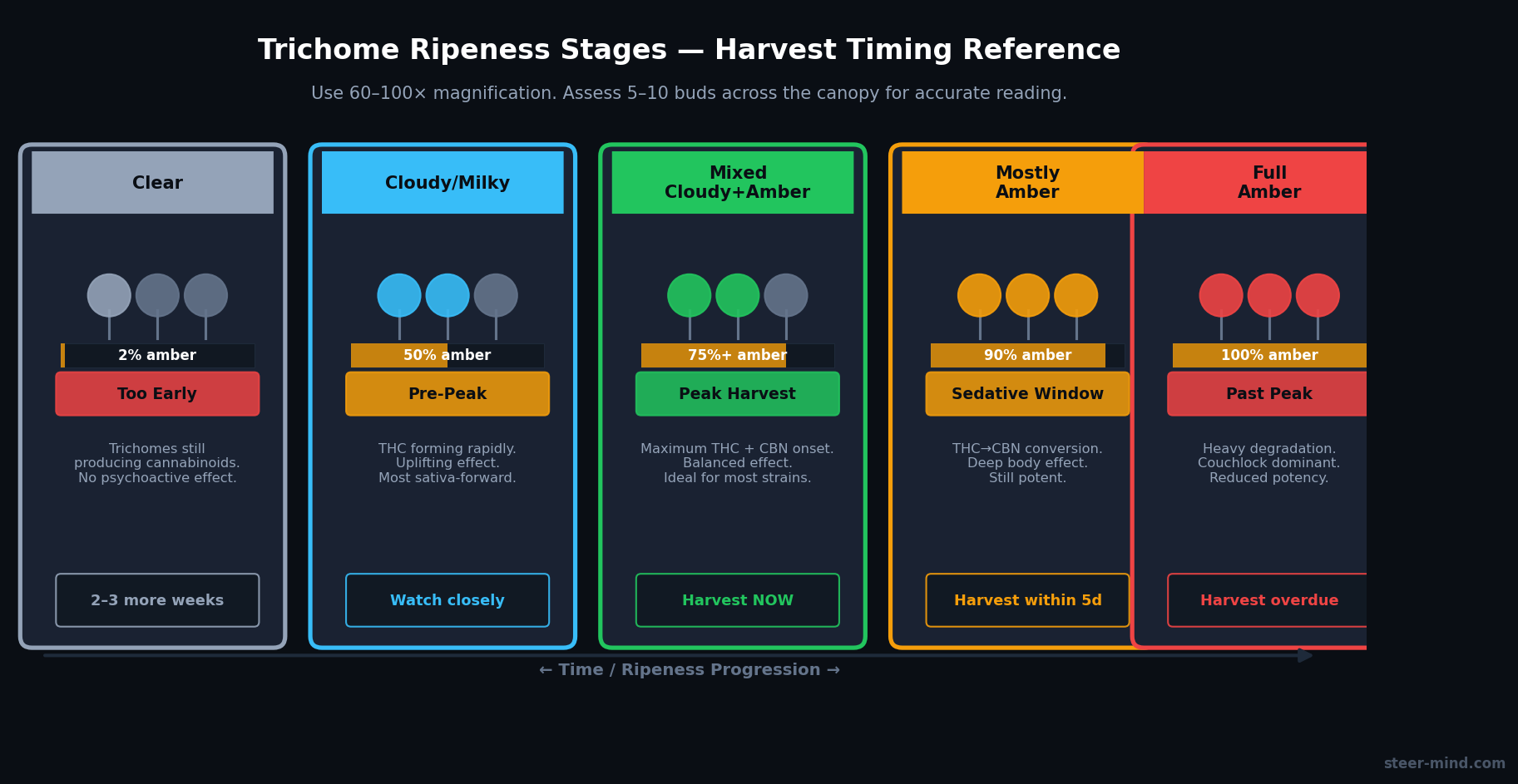
Trichome Structure and Cannabinoid Synthesis
Trichomes are specialized hair-like structures on cannabis flower surfaces. The glandular hairs, particularly capitate-stalked trichomes, produce and store THC, CBD, CBN, and valuable terpenes. These microscopic production factories consist of a stalk cell and a spherical head containing the resin glands.
During the flowering phase, trichomes undergo biochemical maturation. THCa (the inactive, acid-bound form) converts to THC through UV-B exposure and time. Simultaneously, terpenes build up, peak, and partially evaporate. Understanding this process is key to optimal harvest timing.
Science: THC peak and terpene peak are not simultaneous. Terpenes often reach maximum 5-7 days BEFORE peak THC concentration. This makes harvest timing a balance between potency and aroma.
Biochemical Degradation
After THC peak, natural degradation begins. THC oxidizes to CBN (cannabinol), which is less psychoactive but more sedating. Cannabis with high CBN content produces noticeably sedative effects. At full over-ripeness, up to 40% of THC can degrade – your 12-week investment diminishes significantly.
The Four Trichome Stages
| Stage | Color & Appearance | Effect Profile | Recommendation |
|---|---|---|---|
| Clear | Transparent, glassy, shiny | Very low THC concentration, immature, minimal psychoactivity | Do not harvest – wait at least 2-3 more weeks |
| Milky White (Cloudy) |
White, opaque, milk-like | Peak THC concentration, energetic, euphoric, clear-headed | Optimal window for most growers (70-80%) |
| Amber/Brown | Orange to brown coloration | THC beginning to degrade to CBN, sedating, body-focused | Suitable for relaxation-oriented users (20-50% amber) |
| Over-Ripe (>70% amber) |
Predominantly brown, desiccated | Highly sedating, THC significantly degraded, terpenes evaporated | Avoid – potency and aroma severely reduced |
Best Practice: Many growers harvest at approximately 70-80% milky white and 10-20% amber. This balances maximum potency with slightly sedating effects. For high-energy strains, harvest closer to fully milky white (before amber appears).
Why Precise Observation Matters
The difference between stages is enormous. A plant can shift from 40% milky to 60% amber in 3-5 days. In this narrow window, potency differs by up to 25%. Weekly checks starting week 6-7 of bloom are therefore essential.
Reading Trichomes Under Magnification
The Right Tools
- 30-100x Loupe (Jeweler's): Inexpensive ($10-20), portable, sufficient for quick field inspections
- USB Microscope (50-200x): $25-50, digital display, can connect to PC, ideal for documented tracking
- Digital Macro Camera (8-16MP): $40-100, best image quality, allows photo comparisons across days
Step-by-Step Guide
1. Use proper lighting: Use LED light or direct daylight. Artificial light under grow lamps is deceptive – trichomes appear glossier than reality.
2. Focus on upper flower tissue: Inspect the upper leaf bracts and calyxes, not large fan leaves or lower areas. Cannabinoid concentrations vary significantly across tissue types.
3. Inspect the whole bud: Don't examine just one spot. With SCROG or uneven lighting, one side of a bud may ripen faster than another. Check at least 3 different flowers.
4. Frequency: After week 6, inspect weekly. From week 8-9 onward, check every 2-3 days. The transition is rapid.
Common Mistake: Inspecting trichomes under grow lamp lighting. Intense illumination creates gloss effects making clear trichomes look milky. Always use separate, soft lighting for accurate assessment.
Trichome Microscopy: Equipment Guide and Technique
Accurate trichome observation requires proper magnification and technique. You cannot reliably assess trichome ripeness with the naked eye or under basic illumination. The right tools matter significantly, and so does careful sampling methodology.
Equipment Comparison
| Tool | Magnification | Price Range | Field of View | Image Quality | Best For |
|---|---|---|---|---|---|
| 30x Loupe (Basic) | 30x | $8–15 | Narrow | Low (optical distortion) | Quick field checks; not ideal for precision harvest decisions |
| 60-100x Jeweler's Loupe | 60–100x | $15–40 | Very narrow | Medium (glass quality varies) | Standard choice for most growers; reliable if quality glass; portable |
| USB Digital Microscope | 50–200x (adjustable) | $25–80 | Medium | High (digital sensor captures detail) | Best for documentation; compare photos across days; track ripening progression |
| Lab-Grade Microscope | 100x–600x | $200–1000+ | Wide | Excellent (professional optics) | Professional growers; research; unnecessary for harvest timing (overkill) |
Why USB Microscopes Are Recommended
For most home and mid-scale growers, a USB digital microscope ($30–50) is the sweet spot. Reasons: (1) High magnification without optical distortion; (2) Digital images can be compared side-by-side across days to track color progression objectively; (3) Can zoom gradually to focus exactly on trichome heads; (4) Portable; (5) Images serve as harvest documentation for quality control.
Proper Sampling Technique
Trichome maturity varies across the plant. Top buds ripen faster than middle buds, which ripen faster than lower buds. Sugar leaves (small leaves on flower surfaces) ripen faster than calyxes (the actual flower organs). This variation is critical: you must sample from MULTIPLE LOCATIONS to get an accurate harvest timing estimate.
Sampling Protocol
- Select three different bud locations: One from the canopy TOP (most illuminated), one from the MID-LEVEL, and one from the LOWER region of the plant. This ensures you capture the ripening gradient.
- Remove a small sample branch (2–3 inches). Do NOT touch the buds with bare hands; trichomes are extremely delicate and damaged trichomes release cannabinoids immediately, skewing your observation.
- Inspect the CALYCES, not the large sugar leaves. Sugar leaves ripen faster than calyces due to lower cell density. Harvest timing should be based on calyxes—the true flower structures that carry cannabinoids.
- Use separate, soft lighting (LED flashlight or daylight window). Do NOT inspect under grow lamps. Intense grow lamp light creates gloss and reflection artifacts, making clear trichomes appear milky. This is the #1 mistake growers make and leads to early harvesting.
- Examine 2–3 different buds on each sample. Ripeness within a single bud can vary; sample multiple spots on that bud to get a representative assessment.
- Take a photo if using a digital microscope. Save photos with date/time stamps. Over a 2-week ripening window, compare photos to track the clear → milky → amber progression objectively.
- Return sample branches carefully to the plant. If the plant is more than 2 weeks from harvest, the removed branch will regrow; if 1 week or less, keep damage minimal (don't harvest samples during the final week before your harvest date).
Critical mistake: Inspecting under grow lamp illumination or direct sunlight. Both create saturation effects. Use a separate, diffuse light source (LED flashlight or window light away from sun glare) for accurate trichome color assessment.
Pistils as Secondary Confirmation Method
The reddish-brown hairs (pistils) are visual indicators of flower ripeness but are unreliable alone. Pistils darken because they're senescing tissue accumulating anthocyanins. Their color correlates with trichom ripeness but less precisely.
Pistil Ripeness Phases
- 0-50% orange-red: Early flower development, still immature. Do not harvest.
- 50-70% orange-red: Early harvest window, still with ripening potential. Better for energetic effects.
- 70-90% orange-red: Optimal window for many strains, often correlating with 60-80% milky trichomes.
- >90% orange-red: Over-ripe, potential THC-to-CBN conversion already occurring. Ideal only for sedation-seeking consumers.
Why Pistils Alone Are Insufficient
Some genetics color pistils quickly, others slowly. F1 hybrids or certain sativas may show milky trichomes while pistils are still 40% light – or vice versa. Additionally, pistil color varies with genetics, not just ripeness. Use pistils as secondary confirmation, not primary method.
Best Practice: Combine trichom color (primary) with pistil darkening (confirmatory). Trichomes are the more reliable indicator of cannabinoid maturity.
Genetics and Harvest Timing: Indica vs. Sativa Differences
Trichome ripening is genetically controlled. Different lineages—indica, sativa, and hybrids—show distinctly different ripening profiles. Understanding these patterns helps you predict when your strain will be ready and avoid either harvesting too early (immature) or too late (over-ripe).
Indica-Dominant Strains
Indica varieties originate from regions with short growing seasons (Afghanistan, Hindu Kush, Morocco). They evolved to flower quickly and predictably, completing the reproductive cycle in 8–10 weeks from flower initiation.
- Flowering duration: 8–10 weeks (relatively compressed)
- Trichome color progression: Relatively fast and linear. Clear → Milky develops over 2–3 weeks, then Milky → Amber over another 1–2 weeks.
- Trichome ripeness at harvest: Typically 70–80% milky white and 10–20% amber when harvested at peak.
- Pistil behavior: Pistils darken CONCURRENTLY with trichome ripening. When trichomes are 70–80% milky, pistils are usually 70–80% orange-red. Pistils are a reliable secondary indicator for indicas.
- Effect character: THC-forward, rapid onset, relaxing, body-focused. CBN presence (amber trichomes) adds sedation; some growers specifically harvest indicas at 20–30% amber for sleep-aid effects.
- Consistency: Indica ripening is genetically "fixed"—the same strain shows similar ripening profiles across multiple grows.
| Indicator | Early Harvest (Week 8) | Peak Harvest (Week 9) | Late Harvest (Week 10+) |
|---|---|---|---|
| Trichome % | 40–50% milky, 0–10% amber | 70–80% milky, 10–20% amber | 20–30% milky, 60–70% amber |
| Pistil % | 40–50% orange | 70–80% orange | 90–100% orange/brown |
| Effect | Energetic, less sedating | Balanced, potent, clear-headed | Highly sedating, couch-lock |
Sativa-Dominant Strains
Sativas originated in equatorial and near-equatorial regions (Colombia, Thai, Mexican landraces). They evolved under long photoperiods with continuous light. As a result, they flower slowly and unpredictably—some indefinitely if not forced into flower by photoperiod or environmental stress.
- Flowering duration: 10–16+ weeks (significantly longer and more variable)
- Trichome color progression: Slow initial development. Extended CLEAR phase (4–6 weeks) where trichomes remain transparent despite plant vigor. Then rapid transition to Milky over 1–2 weeks, followed by Milky → Amber over 1–2 weeks.
- Trichome ripeness at harvest: Also ~70–80% milky / 10–20% amber, but the timeline is 12–14 weeks instead of 9–10.
- Pistil behavior: UNRELIABLE as indicator. Pistils often remain light or pale even when trichomes are milky. Some sativas show 40% milky trichomes while pistils are still mostly white. DO NOT rely on pistil color for sativas—trichomes only.
- Effect character: THC-forward with distinctive terpene profile (often citrus, floral, fruit). Earlier harvest (higher milky %) yields cerebral, energetic effects. Longer harvest (amber present) adds body stone and relaxation.
- Consistency: Sativa ripening can vary significantly between harvests due to light duration, temperature, and overall vigor. The same genetics may ripen 11 weeks in one season, 13 weeks in another.
Hybrid Strains
Modern commercial hybrids blend indica and sativa traits. Ripening behavior often splits the difference:
- Flowering duration: 9–11 weeks (intermediate)
- Trichome progression: Variable—some hybrids skew more indica (faster), others more sativa (slower). Breeder linearity matters more than simple "55% indica / 45% sativa" labels.
- Pistil reliability: Intermediate. More reliable than pure sativas, less reliable than indicas. Use both trichomes and pistils as cross-checks.
Breeder information: Seed banks and breeders typically provide flowering time (e.g., "8–9 weeks", "12–13 weeks"). This guidance is based on optimal conditions—your results may vary by ±1–2 weeks depending on temperature, light, nutrients, and vigor. Day-counts alone are NOT reliable. Trichome observation is always the final arbiter.
Autoflower Considerations
Autoflowering varieties (ruderalis hybrids) have condensed trichome development windows. Total lifespan is 70–90 days seed-to-harvest. Trichome ripening happens in a compressed timeframe—weeks 8–9 of life often see the full clear → milky → amber progression in just 2–3 weeks. Monitor autoflowers more frequently (2–3 times per week instead of weekly) to catch the optimal harvest window, which closes quickly.
The 48-Hour Darkness Technique: Science vs. Myth
A widespread practice among cannabis growers is turning off lights for 24–48 hours immediately before harvest. Growers report increased trichome production, denser resin, and more intense aroma. The practice has become standard in many elite operations. However, peer-reviewed scientific evidence is limited, making it difficult to separate fact from placebo effect or local conditions.
The Proposed Mechanism
The biological rationale centers on stress physiology. When lights turn off suddenly, the plant perceives an environmental threat—approaching winter or end of season. To maximize reproductive success before dying, the plant upregulates stress hormones, particularly abscisic acid (ABA). ABA is known to trigger secondary metabolite production as a survival strategy, including increased resin (cannabinoids and terpenes) and phenolic compounds.
Additionally, without light, trichomes are not degraded by UV exposure, and terpenes (volatile organic compounds) do not evaporate from heat in the canopy. This preservation effect alone could explain why resin feels "fresher" after darkness.
Evidence and Counter-Evidence
In favor: Anecdotal reports from experienced growers consistently describe increased trichome density, higher apparent THC concentration, and more pronounced aroma after 48-hour darkness. Multiple commercial cultivation facilities employ the practice. The effect is observable on the plant's appearance (glossier, more crystalline buds).
Against: No published peer-reviewed studies specifically measure cannabinoid yield or terpene concentration after 48-hour darkness vs. normal harvest. The effect could be confounded by harvest timing accuracy (growers may simply harvest more precisely after darkness, hitting peak ripeness). Placebo effect is possible in small-scale grows.
Practical Recommendation
The 48-hour darkness technique is LOW-RISK and potentially HIGH-REWARD, especially for premium or high-value strains. Reasons to try it:
- No safety concerns (darkness is not harmful to plants 48 hours before harvest).
- Low cost (turn off lights; no extra inputs).
- Observable effect on appearance (increased trichome visual density).
- May provide marginal potency or aroma boost (5–15% based on grower reports).
Guidelines if implementing:
- Maintain stable temperature: Without grow lights, canopy temperature drops. Ensure the room doesn't cool below 18°C, which can stress the plant. Use ambient heating if needed.
- Do NOT overwater during darkness: Without photosynthesis, the plant has no energy to process water. Roots can rot if substrate is waterlogged during 48 hours of darkness. Verify substrate moisture is just slightly moist (not wet) at light-off.
- Harvest immediately after darkness period: After lights return (or at 48-hour mark), harvest immediately. Prolonged darkness beyond 48 hours risks bud rot and pest issues (darkness attracts fungal growth).
- Reserve for premium strains: The technique is worthwhile for genetics you've grown multiple times or for high-value crops. For experimental or budget grows, it's optional.
Bottom line: 48-hour darkness is a reasonable, harmless optimization tactic with significant anecdotal support. It is NOT a requirement for quality harvest, and the magnitude of benefit is probably modest (5–15%). Use it as a refinement technique when harvest timing is already locked in via trichome observation.
Frequently Asked Questions
How do I use a magnifier correctly for trichome inspection?
Use a 30-100x handheld loupe or USB microscope with at least 50x magnification. Look directly at upper bract leaves and calyxes, not large fan leaves. Hold the magnifier perpendicular to the bud and focus on the spherical trichome heads. Good lighting is essential – use LED or natural daylight.
Can trichomes be damaged by touching?
Yes, trichomes are very fragile. Avoid direct contact with flower areas during inspection. Wear gloves or use a no-contact microscope. Damaged trichomes release cannabinoids and terpenes immediately and cannot rebuild.
Why do some cannabis strains look perpetually clear?
Some genetics, especially sativa-dominant strains, show an extended clear phase before trichomes turn milky. This is genetically normal. Wait for the milky phase or check pistils as secondary indicator. Strain genetics significantly affect trichome color development.
What does the '2-week flush window' mean?
This theory suggests that after switching to 12/12 light, about 2 weeks are needed before visible flower development. Practice shows that flushing 1-2 weeks before expected harvest is useful to reduce nutrient residue. Based on experience, not strict science.
How do I identify harvest timing for autoflowers with their short lifespan?
Use the same trichome criteria but monitor more frequently. Check from week 8-10 onward. The total lifespan is shorter (70-90 days), leaving less time for decision-making. Autoflowers ripen faster and less linearly than photoperiods – weekly inspections are recommended.