Harvest
Drying and Curing Cannabis: Temperature, Humidity, and Timeline for Best Results
Drying and curing are the most critical phases after harvest. Even the best genetics and perfect bloom can be ruined here – or transformed into premium quality through patient curing. This guide explains the biochemistry and practical steps for maximum aroma and potency.
Biochemistry of Drying and Curing
After harvest, complex biochemical transformations occur. The still-living plant cells dehydrate, and during this time important metabolic reactions proceed:
Chlorophyll Breakdown
Chlorophyll is the green pigment essential in living leaf tissue. After harvest, slow drying allows chlorophyllase enzymes to break it down – producing the pale golden appearance and eliminating the grassy, green taste. Rapid drying (>25°C or too-dry air) preserves chlorophyll. Result: green, hay-smelling cannabis.
Starch Conversion to Sugars
Plant starch is enzymatically converted to simple sugars. These sugars contribute sweet taste and are fermentable – important for flavor development during curing. This process requires optimal moisture (45-55% RH) and temperature (18-21°C).
Terpene Dynamics
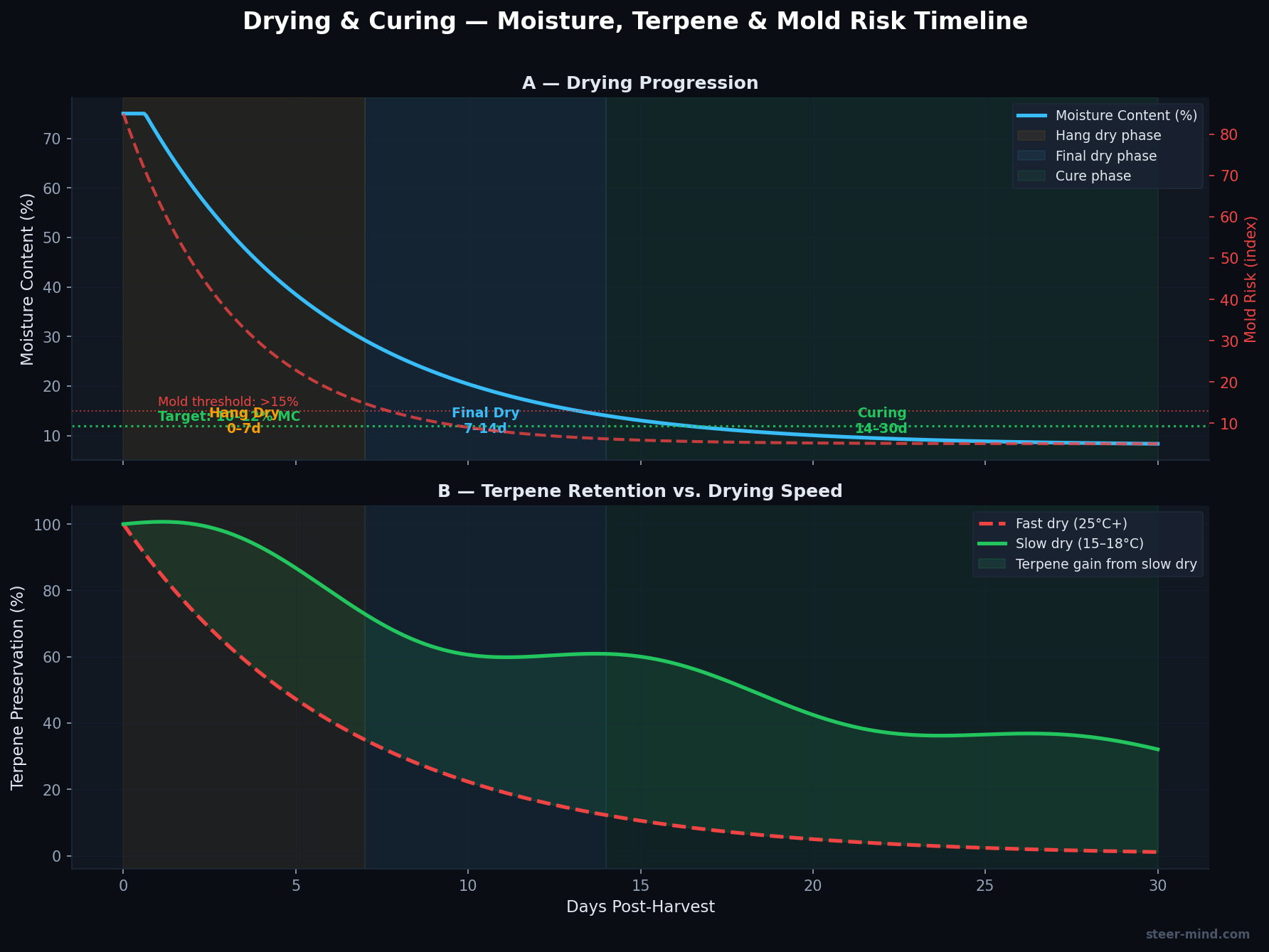
Terpenes are volatile organic compounds. Temperatures above 38°C cause rapid evaporation and loss. Too-dry air (<40% RH) accelerates water loss, triggering faster terpene evaporation. Optimal drying preserves terpenes while water is expelled.
Key Point: Slow drying at 18-21°C and 45-55% RH enables chlorophyll breakdown, starch conversion, and terpene preservation. This is intentional chemistry, not a mistake.
The Drying Phase: Conditions and Timing
Ideal Drying Environment
| Parameter | Optimal | Acceptable | Problematic |
|---|---|---|---|
| Temperature | 18-21°C | 15-24°C | <15°C or >25°C |
| Relative Humidity | 45-55% RH | 40-60% RH | <35% or >65% RH |
| Light | Complete darkness | Minimal light | Bright or direct sunlight |
| Air Movement | Gentle, indirect circulation | Weak airflow | Direct fan on buds |
| Duration | 10-14 days | 7-18 days | <5 or >21 days |
Step-by-Step Preparation
1. Trimming (optional): Remove large fan leaves immediately after harvest (wet-trim) or wait until after drying (dry-trim). Both methods have trade-offs.
2. Hanging with stems: Hang buds by stems – not on racks or cloths. The stem acts as a water-transport pathway, enabling slow inside-to-outside drying.
3. Bud spacing: Buds should not touch. Minimum 5-10 cm gap enables air circulation and prevents condensation and mold.
4. Room ventilation: An inline fan (not directed at buds) with carbon filter creates gentle air movement and removes humidity. Adjust speed so buds move slightly when disturbed.
Pro Tip: Place hygrometer and thermometer at bud height, not on walls. Room air can differ significantly from conditions near drying buds.
Drying Checkpoint: The Stem Bend Test
After 7-10 days: Take a bud and try to bend the stem. At the end of drying, the stem should snap – not splinter, but with audible, clear snap. If the stem still bends without snapping, dry 2-3 more days. If already shattering (brittle), stop – over-dried.
Curing in Detail: Process, Burping, and Duration
After drying, curing begins – a multi-week air-tight storage. During curing, a second set of transformations occurs:
What Curing Biochemically Achieves
- Remaining Chlorophyll Traces: Further degraded for sweeter, more complex flavor.
- Cannabinoid Conversions: THCa converts to THC, CBDa to CBD. Slow process.
- Terpene Stabilization: Under air-tight seal, terpenes stabilize with no further evaporation loss.
- Moisture Equilibration: Moisture distributes evenly between buds for consistent humidity.
Mason Jar Setup
Use glass mason jars (1-2 liter size, not oversized). Fill 50-75% with dried buds. Too full = moisture problems, too empty = excess air space.
Burping Process (Week 1)
Week 1: Open and close daily or 2x daily for 15-30 minutes. This allows humidity equilibration and gas release (CO2, ethylene). Without burping, anaerobic processes develop and flavor turns "urine-like".
Weeks 2-3: Burp 3-4x per week for 15-30 minutes.
Week 4+: Burp only weekly briefly. After 4 weeks, curing is at optimal window.
Perfectly Cured Cannabis: After 4-8 weeks curing, optimal flavor is reached. Extended curing (12+ weeks) shifts profile slightly more sedating, with slightly higher potency through THCa conversion.
Humidity Indicator
Ideal is 62% RH (absolute jar humidity). This is the "Equilibrium Moisture Content" (EMC) for cannabis, making mold very unlikely while preserving terpenes. Below 55% RH becomes too dry, above 70% RH significantly increases mold risk.
Common Mistakes and Their Consequences
Mistake 1: Too-Rapid Drying (Hay Smell)
Causes: Hot drying room (>25°C), fan directly on buds, too-dry air (<35% RH).
Consequence: Chlorophyll preserved, terpenes evaporated, flavor grassy and flat.
Recovery: Extended curing (6-8 weeks) helps partially, but aroma won't fully recover.
Mistake 2: Too-Humid Curing (Mold Risk)
Causes: Over-humid jars (>70% RH), insufficient burping week 1, jarring too-wet buds.
Consequence: Gray/white fuzz on buds = Botrytis or mold. Harvest lost.
Recovery: Open jars immediately, re-hang buds to dry (only 2-3 days at >55% RH). Musty smell means mold toxins already present.
Mistake 3: Jarring Too Early (Pre-Stiel Snap)
Causes: Impatience, no hygrometer monitoring.
Consequence: Too-humid jars, uncontrolled fermentation, musty/compost-like smell. Sugar breakdown becomes uncontrolled.
Mistake 4: Over-Drying
Causes: Forgotten in dry room, too-long drying duration.
Consequence: Brittle buds, break easily, harsh burning flavor.
Recovery: Still cure – humidity reabsorption during curing can improve mouthfeel.
Terpene Preservation During Drying: Temperature and Airflow Science
Terpenes are the aromatic compounds that define cannabis flavor and effect. They are also volatile — readily lost during drying if conditions aren't carefully controlled. Understanding terpene chemistry helps you preserve the profile you've spent weeks developing.
Terpene Boiling Points and Evaporation at Room Temperature
A common misconception: "Terpenes don't evaporate at room temperature because their boiling points are higher." This is partially true, but misleading. Terpenes DO evaporate significantly at room temperature — just not instantly.
| Terpene | Boiling Point | Evaporation Rate at 20°C | Loss After 7 Days at 25°C |
|---|---|---|---|
| Myrcene (earthy) | 167°C | High | 15–25% |
| Limonene (citrus) | 176°C | High | 10–20% |
| Linalool (floral) | 198°C | Moderate | 8–15% |
| Pinene (pine) | 156°C | Very High | 20–30% |
| Caryophyllene (spicy) | 219°C | Low | 3–8% |
Why High Drying Temperatures Cause Permanent Terpene Loss
When a drying room exceeds 25°C, evaporation accelerates exponentially. The chart above shows loss at 25°C; at 30°C or higher, losses are much steeper. The mechanism:
- Molecular energy: Higher temperature = higher molecular kinetic energy → terpenes escape the bud matrix more readily.
- Vapor pressure: At higher temps, terpene vapor pressure increases, driving evaporation.
- Irreversible loss: Unlike water (which can be reabsorbed during curing), evaporated terpenes are gone. You cannot recover them.
Optimal Conditions for Terpene Preservation: Cool, Slow Drying
Temperature: 18–21°C (target 19°C if possible)
- Below 15°C: drying stalls, mold risk increases
- 18–21°C: terpene evaporation minimized, chlorophyll breakdown continues
- Above 25°C: rapid evaporation, terpene loss increases sharply
Relative Humidity: 50–60% RH (target 55% RH)
- Below 40% RH: very dry air accelerates all evaporation (water + terpenes)
- 50–60% RH: sweet spot — water leaves bud, but humidity slows terpene escape
- Above 65% RH: water loss slows, drying extended, mold risk rises
Air Circulation: Gentle, Indirect Flow
- Direct fan on buds: Accelerates surface drying, increases terpene loss by 15–30%
- No airflow: Mold risk, uneven drying
- Gentle circulation (fans pointing at walls, not buds): Optimal. Air moves, but buds aren't directly exposed to wind.
Practical Terpene Preservation Protocol
-
Trim before drying (wet-trim)
Remove large fan leaves immediately after harvest. Sugar leaves stay on. Wet-trim slightly increases drying speed (good) and exposes less trichome-covered surface to air.
-
Hang buds vertically, not on racks
Hanging allows water to transport slowly down the stem. Racks and cloths expose large surface area, increasing terpene evaporation.
-
Seal the drying room
Windows closed, doors sealed, exhaust fan runs continuously at low speed. No fresh air intake (air comes from cracks). Objective: maintain 55% RH and 19°C.
-
Temperature control is critical
If room runs warm, use AC or active cooling. A few degrees cost you noticeable terpene loss. If you can't maintain 18–21°C, prioritize staying below 23°C at least.
-
Drying time: 10–14 days at 18–21°C
If you're drying faster (7 days or less), it's likely too warm. If slower (18+ days), too humid or too cool.
Terpene Math: Drying at 20°C vs. 28°C: you lose ~15% more terpenes at the higher temperature. Over a premium cannabis batch, that's meaningful flavor and potency difference.
Burping Schedule and Cure Indicators: Week-by-Week Guide
Curing is not passive storage. Active management during the first 4 weeks determines final quality. Here's a detailed week-by-week protocol with what to expect:
Week-by-Week Burping Schedule
| Week | Burping Frequency | Duration per Burp | What to Check | Expected Smell |
|---|---|---|---|---|
| Week 1 | 2x daily | 15 min (morning + evening) | Moisture level (should be tacky, not wet). Look for condensation on jar inside (= too wet, dry longer). Smell: fresh grass, slight earthy. | Fresh grass, green, slightly earthy |
| Week 2 | 1x daily | 20–30 min | Moisture equilibrating. Condensation should disappear. Buds should feel dry outside, slightly tacky inside. Stem: bends slightly but doesn't snap (still some moisture in center). | Grass fading, more herbal/earthy notes, sometimes hay-like (normal at this stage) |
| Week 3 | 1x every 2 days | 15–20 min | Moisture should be stable (62% RH target). No condensation. Buds crispy outside, dry inside (but not brittle). Sweet, complex smell emerging. | Herbal/hay smell fading, floral/fruity notes appearing |
| Week 4+ | 1x weekly | 5–10 min | Maintenance mode. RH stable, buds cure passively. Monthly checks for mold/moisture. | Complex: floral, fruity, original strain profile |
Smell Progression: How to Recognize Good vs. Bad Curing
Good Curing Progression:
- Days 1–3: Fresh grass smell (chlorophyll still present). Expected.
- Days 4–7: Grass smell fades, earthy/hay notes appear (chlorophyll breaking down). Expected.
- Week 2–3: Hay smell gradually replaced by floral/fruity notes (terpenes stabilizing). This is the turning point.
- Week 4+: Complex profile: original strain flavor emerges (limonene, myrcene, etc.). Sweet, herbal, fruity, spicy — depending on genetics.
Bad Curing Indicators (When Something Went Wrong):
- "Ammonia" or "urine" smell (week 2–3): Anaerobic fermentation in too-wet jars. Means: insufficient burping or jarred too early. Partially recoverable with increased burping and airflow, but never fully corrected.
- Persistent "hay" smell beyond week 3: Indicates too-rapid initial drying (temperature too high, RH too low). Terpenes were lost during drying. Curing won't recover them — this is permanent.
- Musty/moldy smell: White or gray fuzz visible = Botrytis or mold. Harvest lost. Must be discarded.
- No smell at all / very faint (week 4+): Over-dried buds. Terpenes evaporated completely. Taste will be harsh, flat.
Practical Cure Decision Tree
At Week 4, you must decide: Do I continue curing, or use the product?
- Complex, pleasant smell + crispy outside/slightly tacky inside + 4 weeks elapsed: Product is ready. Can switch to Boveda and store, or use now.
- Still hay-like smell + 4 weeks elapsed: Extend curing to week 6–8 (helps but won't fully recover). Or accept the loss and use now.
- Musty smell + visible fuzz: Discard immediately. Safety first.
Pro Tip: Take a small sample (few buds) at week 2 and test smoke/vape it. This tells you if drying was too fast (harsh taste) or if curing is on track. Adjust burping frequency based on this feedback.
Boveda vs. Integra vs. Manual Burping
Boveda Packs (62% or 58% RH)
Function: Absorb/release gels regulate jar humidity to set RH level.
Advantages: Hands-free, no burping needed, very consistent, ideal long-term.
Disadvantages: Higher cost (~$1-2 per pack), not ideal during active fermentation (first 2 weeks).
Best Use: After 2 weeks manual curing, switch to Boveda for long-term storage.
Integra Boost Packs
Similar to Boveda, alternative brand with same principle. Slightly cheaper, equal quality.
Manual Burping (No Packs)
Function: Daily opening/closing for humidity equilibration and gas release.
Advantages: Free (except jars), maximum control, learn plant behavior.
Disadvantages: Requires discipline and presence, higher error potential, oxidation and light exposure at each burp.
Professional Method: Hybrid: First 2 weeks intensive manual burping, then Boveda packs for remaining weeks and long-term storage. Best of both worlds.
Frequently Asked Questions
Should I remove leaves before drying (wet trim)?
Wet-trim (immediately after harvest) allows faster drying but requires care to avoid resin loss. Dry-trim (after drying) preserves more terpenes and is simpler, but extends total time. Professionals often use a hybrid approach: remove large fan leaves, leave sugar leaves on buds initially.
How should properly dried buds feel?
Properly dried buds should feel crispy on the outside (stems snap audibly when bent), but slightly tacky inside. No moisture-sticky feeling, but not brittle like paper either. Stem test: when bent, it should snap cleanly with a distinct sound, not splinter.
How long does cured cannabis remain usable?
With optimal curing (62% RH, 15-18°C, dark), cannabis remains usable for 1-2 years. THC degrades slowly – after 1 year approximately 10-15% potency is lost. Hot, bright, or humid storage accelerates degradation significantly. Long-term storage requires UV protection and cool temperatures.
Why does my cannabis smell like hay?
Hay smell results from rapid drying or insufficient curing. Chlorophyll wasn't fully degraded. Causes: drying room too warm (>25°C), too dry air (<40% RH), or insufficient curing time (<2 weeks). Extended curing helps partially, but aroma won't fully recover.
Should I use Boveda, Integra, or manual burping?
Boveda and Integra auto-regulate RH at 62-67%. Without packs you must manually burp (air). With packs: minimal effort, optimal control, but higher cost. Best hybrid: active burping first 2 weeks, then packs for long-term storage. Manual gives more control but requires discipline.