Nutrients
Magnesium Deficiency in Cannabis: Recognition and Treatment
Magnesium is the central atom in the chlorophyll molecule and a cofactor for over 300 enzymatic reactions. Its deficiency manifests through characteristic interveinal chlorosis and develops quickly because magnesium is a mobile nutrient that migrates from older to new leaves. This guide shows you how to reliably diagnose magnesium deficiency, distinguish it from other deficiencies, and correct it.
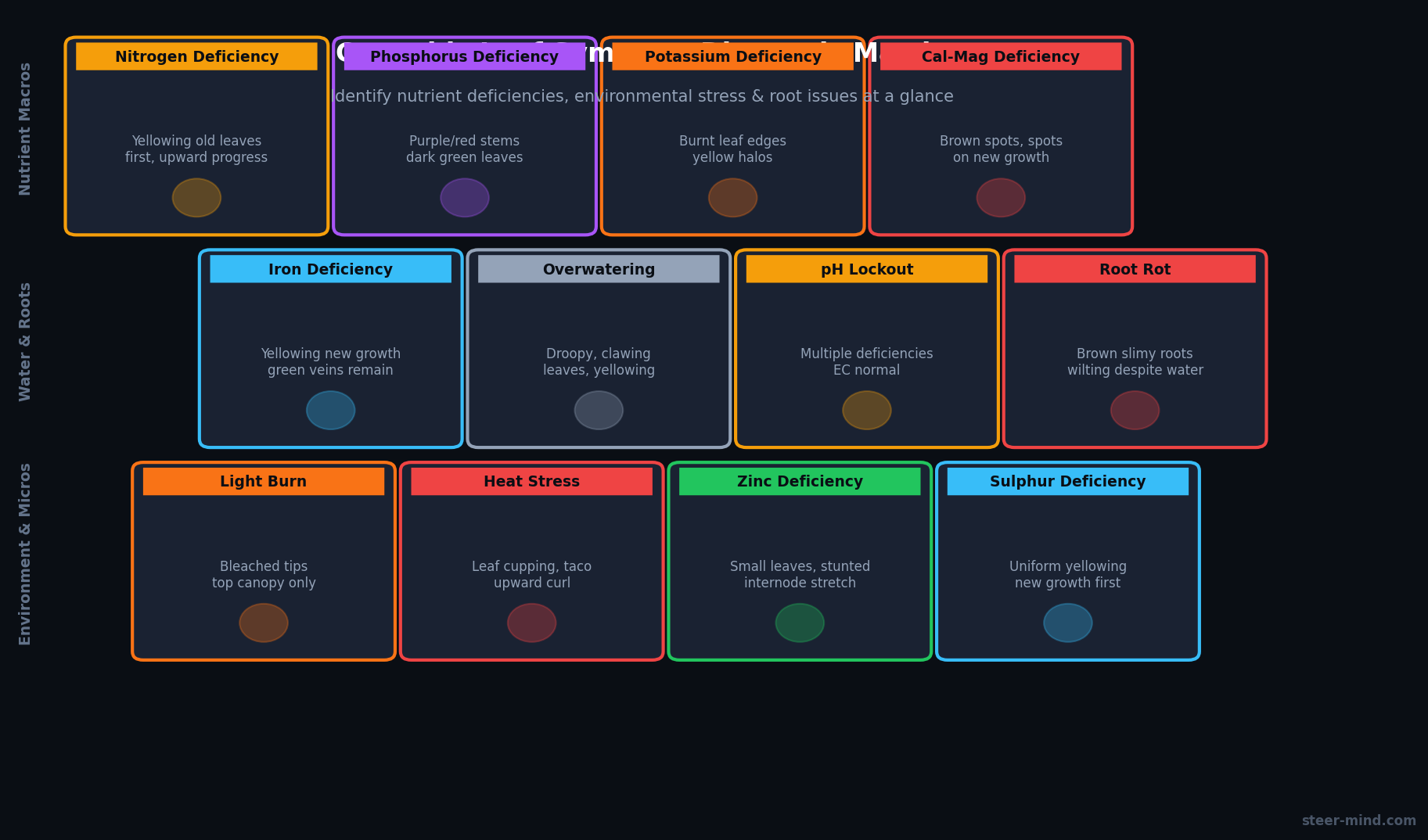
Recognizable Signs and Symptoms
Magnesium deficiency manifests through a distinctive pattern:
- Interveinal chlorosis: Leaf veins remain dark green while the tissue between them turns yellow to pale yellow.
- Distribution: Begins on older, lower leaves and moves upward.
- Timeline: Can become visible within 3–5 days.
- Late stage: Necrotic brown spots on the leaf surface.
- Growth: Overall slowed growth, shorter internodes.
Hallmark sign: Interveinal chlorosis (green veins, yellow tissue) is pathognomonic for magnesium deficiency.
Causes and Triggering Factors
pH too low
The most common cause is pH below 5.5 in coco or DWC systems. At low pH, hydrogen ions (H⁺) displace magnesium from root uptake sites, even though magnesium is present in solution.
Calcium excess and antagonism
Calcium and magnesium compete for the same transport mechanisms in the plant. Excess calcium can block magnesium uptake even when Mg is present in adequate amounts.
High potassium dosing
Potassium and magnesium share similar uptake pathways. PK boosters and potassium-rich bloom fertilizers can cause Mg deficiency if CalMag is not increased in parallel.
Low substrate or root zone temperature
Magnesium uptake is temperature-dependent. Root zones below 16°C lead to reduced ion uptake.
Depleted or lime-poor substrate
Old or reused substrates can have magnesium leached out.
Practice tip: Check pH first — it's the quickest and most common solution. A simple dropper test or digital pH meter gives clarity in seconds.
Distinguishing from Similar Deficiencies
Multiple nutrient deficiencies cause yellowing. Precise distinction is crucial to apply the correct remedy.
| Deficiency Type | Symptom Pattern | Affected Leaves | Character |
|---|---|---|---|
| Magnesium | Interveinal chlorosis (green veins, yellow tissue) | Old leaves, moving upward | Sharp definition along veins |
| Nitrogen | Uniform yellowing | Old leaves, entire structure | Diffuse, no vein pattern |
| Potassium | Leaf margin necrosis (brown edges) | Old leaves, edges and tips | Necrotic spots at margin |
| Iron | Interveinal chlorosis (new leaves) | Young leaves at the tip | Light yellowing at top |
| Manganese | Gray or brown spots | Young and old leaves | Dots, no continuous border |
Iron vs. Magnesium
Iron deficiency also shows interveinal chlorosis but appears on young leaves at the top and often results from pH too high. Magnesium deficiency starts on old leaves at the bottom. When in doubt: check pH and slightly increase both iron and magnesium.
Correction and Treatment
Step 1: Check and correct pH
Before adding CalMag, measure the pH:
- Coco/Coconut mix: Target range 5.8–6.2
- DWC/Hydroponics: Target range 5.5–6.0
- Soil: Target range 6.0–6.5
If pH is too low, raise it with pH-Up. A pH increase from 5.2 to 6.0 often resolves 50–70% of symptoms within 3 days without additional supplements.
Step 2: Dose CalMag
Use an established CalMag product and follow the dosing instructions:
- Standard dosing: 1–2 mL/L depending on product and water hardness
- Hard tap water (>200 ppm): Reduce the dose or dilute with distilled water
- Target magnesium: 40–60 ppm in the nutrient solution
Mix CalMag after the calcium salt and before other fertilizers.
Step 3: Foliar spray (emergency)
If you need faster results, use Epsom salt (MgSO₄) as a foliar spray:
- Dissolve 20 g Epsom salt in 1 L water
- Spray in the evening (not at midday heat)
- Repeat every 3–5 days until symptoms stop
- Spray leaf undersides — that's where most stomata are
Important: Foliar spray works faster (1–2 days) but doesn't replace root correction. Address pH or root nutrition at the same time, or the deficiency will return.
Prevention and Solution Design
CalMag from the start
Many growers only see magnesium deficiency late. Better: dose CalMag from clone/seedling onward:
- Vegetative phase: 1–1.5 mL/L
- Flowering phase: 1–2 mL/L (higher demand)
Water quality matters
Hard tap water contains calcium and magnesium and must be factored into CalMag dosing:
- Measurement: EC meter or water hardness test
- Calculation: If tap water already contains 150 ppm, reduce CalMag accordingly
- Soft water: Needs full CalMag dosing
pH stability
Fluctuating pH is a major factor in magnesium deficiency. Invest in:
- A good digital pH meter (calibrate before each use)
- pH buffers or stable fertilizer systems
- Daily pH checks (for hydroponic systems)
Use PK boosters sparingly
PK boosters contain high potassium and can displace magnesium through antagonism. Guidelines:
- PK booster from week 3–4 of flowering
- Never exceed 30–40% of base dose
- Slightly increase CalMag in parallel (by 25–50%)
Magnesium target values by growth phase
| Phase | Mg Target (ppm) | Typical CalMag Dose | Notes |
|---|---|---|---|
| Clone/Seedling | 30–40 | 0.8–1 mL/L | Weak plants need less; overdose harms |
| Vegetation | 40–50 | 1–1.5 mL/L | Stable supply for growth |
| Early flowering | 50–60 | 1.5–2 mL/L | Higher demand with bloom switch |
| Late flowering (week 7+) | 40–50 | 1–1.5 mL/L | Slight reduction, flush approaching |
Magnesium vs. iron deficiency: how to tell them apart
Both magnesium and iron deficiency cause yellowing between leaf veins (intervenal chlorosis), and growers frequently confuse the two. The key difference is which leaves are affected first: magnesium is semi-mobile and deficiency appears on older middle leaves first; iron is immobile and deficiency appears exclusively on the newest growth.
| Feature | Magnesium Deficiency | Iron Deficiency |
|---|---|---|
| Leaf age affected | Middle/older leaves first | Newest growth only |
| Chlorosis pattern | Intervenal, veins stay green | Intervenal, nearly white between veins |
| Progression speed | Gradual over days | Rapid (days to complete bleach) |
| Most common cause | Low Mg in feed, high K competition | pH above 7.0 or below 5.5, Mn competition |
| Quick fix | 1–2 g/L MgSO4 foliar spray | Correct pH to 5.8–6.2 first; Fe-EDTA if needed |
Frequently Asked Questions
How do I distinguish magnesium deficiency from nitrogen deficiency?
Magnesium deficiency shows interveinal chlorosis: veins stay green while the tissue between yellows. Nitrogen deficiency causes uniform yellowing of the entire leaf surface.
Why does low pH cause magnesium deficiency?
At pH below 5.5, hydrogen ions compete with magnesium for root uptake sites. Correcting pH to 5.8–6.2 usually restores magnesium uptake immediately.
How do I dose CalMag correctly?
Standard dosing is 1–2 mL/L depending on product and water hardness. Target: 40–60 ppm magnesium. For hard water, reduce the amount or use distilled water.
Can I foliar spray magnesium deficiency with Epsom salt?
Yes, dissolve 20 g Epsom salt in 1 L water and spray leaf undersides in the evening every 3–5 days. Works faster than root feeding but requires simultaneous root correction.
Why does high potassium cause magnesium deficiency?
Potassium and magnesium compete for the same uptake sites (antagonism). Excess potassium displaces magnesium. Increase CalMag when potassium exceeds 1,000–1,200 ppm.