Nutrients
pH for Cannabis in Coco: What Range Works and How to Hold It There
In coco, pH is not a cosmetic number. It decides which nutrients stay available, how cleanly the root zone runs, and how reliably the plant responds to feed changes.
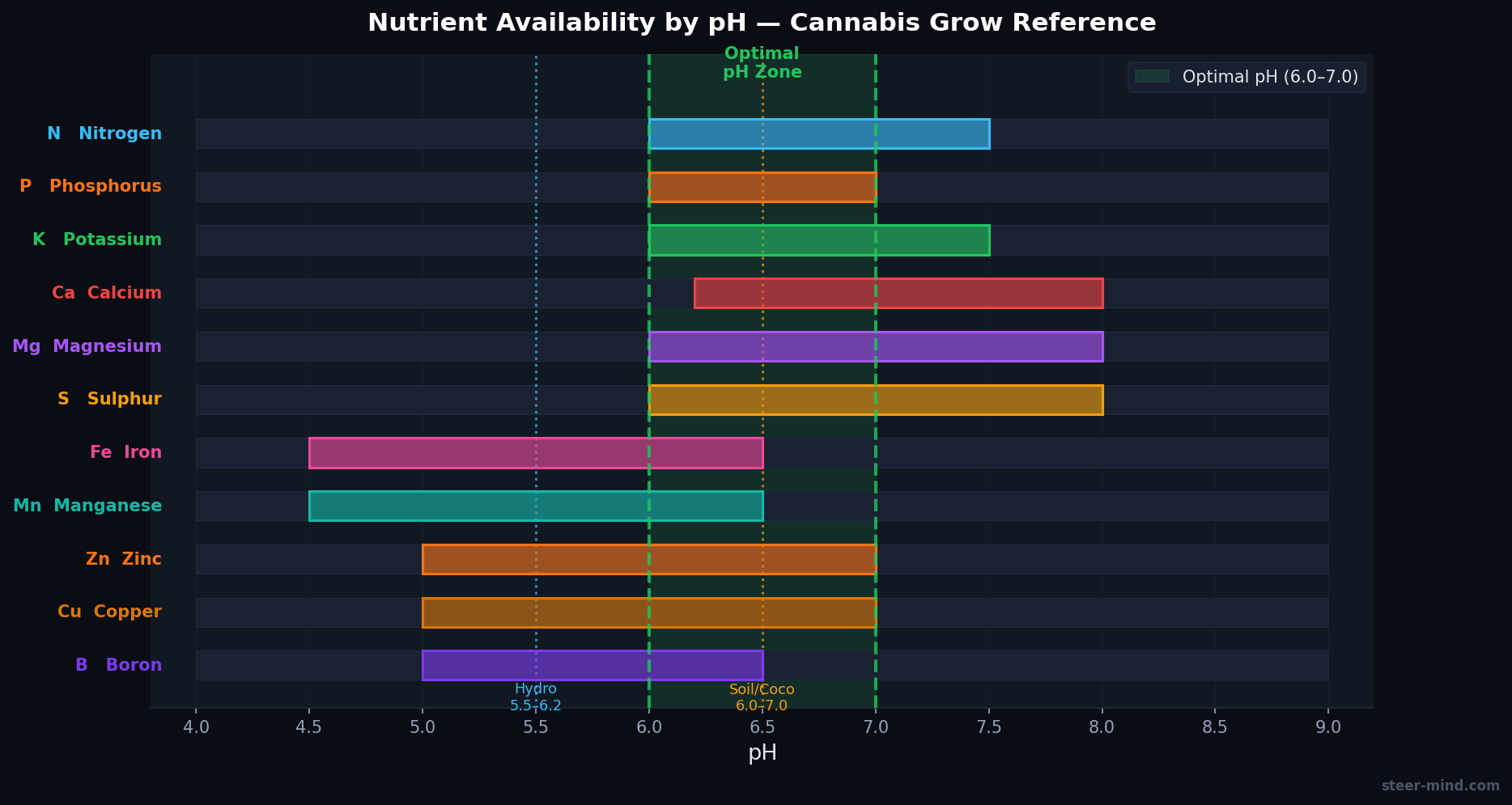
Why pH Matters in Coco
The pH of the nutrient solution determines which elements are available for root uptake. Cannabis roots absorb nutrients as dissolved ions, and the solubility of each ion depends directly on the pH of the solution surrounding the root zone. In coco coir, this relationship is even more critical than in soil because coco has virtually no natural pH buffering capacity once its cation exchange sites are saturated.
At the correct pH (5.8-6.2), all essential macro- and micronutrients are simultaneously available. Move outside this window, and specific elements begin to precipitate or form insoluble compounds:
- Below pH 5.5: Calcium, magnesium, and phosphorus availability drops sharply. Manganese and aluminum can reach toxic concentrations.
- Above pH 6.5: Iron, manganese, zinc, copper, and boron become increasingly unavailable. Iron deficiency is the most common symptom of high-pH lockout in coco.
- pH 5.8-6.2: The sweet spot where all 16 essential nutrients are simultaneously soluble and available to the plant.
Target pH Values by Growth Phase
While the general range is 5.8-6.2, fine-tuning the target pH by growth phase optimizes nutrient availability for the plant's changing requirements.
| Growth Phase | Input pH | Runoff pH Target | Priority Nutrients |
|---|---|---|---|
| Seedling / Clone | 5.8 - 6.0 | 5.8 - 6.2 | N, Ca, Mg for root establishment |
| Early Veg | 5.8 - 6.0 | 5.8 - 6.2 | N, Fe, Mn for leaf expansion |
| Late Veg | 5.9 - 6.1 | 5.8 - 6.2 | N, K, Ca for structural growth |
| Early Flower (Stretch) | 6.0 - 6.2 | 5.9 - 6.3 | P, K, Ca for flower initiation |
| Mid Flower (Bulk) | 6.0 - 6.2 | 5.9 - 6.3 | P, K, Mg for flower development |
| Late Flower (Ripen) | 6.0 - 6.2 | 5.9 - 6.3 | K, S for resin and terpene production |
The slight upward shift during flower reflects the plant's increased demand for phosphorus and potassium, both of which are more available at pH 6.0-6.3. At the same time, micronutrient demand decreases relative to total uptake, so the slight trade-off in iron and manganese availability is acceptable.
How to Measure pH Correctly
Equipment Options
Three types of pH meters are commonly used in cannabis cultivation:
- Digital pH pen (recommended): Accuracy of +/- 0.1 pH. Budget models (Apera PH20, Bluelab pH Pen) cost $50-100 and are sufficient for most growers. Calibrate weekly with pH 4.0 and 7.0 buffer solutions.
- Continuous pH monitor: Inline probes (Bluelab Guardian, HM Digital) provide real-time readings. Ideal for automated systems. Higher cost ($150-400) but eliminates measurement error from grab samples.
- pH drops / test strips: Cheap but imprecise (+/- 0.5 pH). Not recommended for coco cultivation where precision matters. Acceptable only as a backup when your digital meter is out of commission.
Measurement Protocol
- Input pH: Mix your nutrient solution fully, wait 2-3 minutes for the pH to stabilize, then measure. Always add nutrients before adjusting pH — nutrients shift the pH significantly.
- Runoff pH: Collect runoff from the second or third irrigation event of the day (not the first — the first event flushes overnight accumulations and gives unrepresentative readings). Measure within 5 minutes of collection; pH changes as CO2 equilibrates with air.
- Root zone pH: The pour-through method provides the most accurate root zone reading. Irrigate until you get 50-100 ml of runoff, then immediately measure that runoff. This represents the actual solution surrounding the roots.
Adjusting pH: Up and Down
pH Down (Lowering pH)
The most common adjustment in coco cultivation. Tap water and most nutrient concentrates produce a solution above pH 6.5 before adjustment.
- Phosphoric acid (H3PO4): The standard choice. Adds a small amount of phosphorus. Use the diluted form (10-30%) for better control. Approximately 0.5 ml of 30% phosphoric acid per 10 liters drops the pH by ~1.0 unit (varies with water alkalinity).
- Nitric acid (HNO3): Preferred during vegetative growth because it contributes nitrogen. More aggressive than phosphoric acid — use smaller doses.
- Citric acid: Organic option but unstable. pH tends to creep back up within hours as microbes metabolize the citric acid. Not recommended for recirculating systems.
pH Up (Raising pH)
Less commonly needed in coco, but necessary when using RO water with acidic nutrient lines.
- Potassium hydroxide (KOH): The cleanest option. Contributes potassium. Very concentrated — add drop by drop.
- Potassium silicate: Raises pH while providing bioavailable silicon. Dual benefit for stem strength and pathogen resistance. Add before other nutrients and let the solution stabilize for 15 minutes.
- Sodium bicarbonate (baking soda): Emergency option only. Adds sodium, which competes with potassium and calcium uptake. Avoid regular use.
Understanding and Preventing pH Drift
pH drift refers to the gradual change in root zone pH between irrigation events. In coco, pH almost always drifts upward due to the substrate's cation exchange properties.
Why Coco Pushes pH Up
Coco's CEC sites preferentially bind divalent cations (Ca2+, Mg2+) while releasing monovalent cations (K+, Na+) and hydrogen ions. As calcium and magnesium are stripped from solution and replaced by potassium and sodium, the net effect is a rise in pH. This process is continuous but most pronounced in:
- Freshly buffered coco (first 2-3 weeks of use)
- Periods of low runoff (salts and exchange products accumulate)
- Extended dry-back periods (concentrating the root zone solution)
How to Prevent Drift
- Maintain adequate runoff (15-20%): Sufficient runoff flushes exchange products before they accumulate.
- Use properly buffered coco: Pre-treat with Ca/Mg solution (EC 0.8-1.2) for at least 8 hours before first use.
- Feed multiple times daily: Frequent fertigation events reset the root zone pH before drift becomes significant. In coco, 3-6 events per day is standard during active growth.
- Monitor runoff pH daily: Catching drift early (within 0.2-0.3 units) is far easier to correct than addressing advanced lockout.
pH-Induced Nutrient Lockout
Nutrient lockout occurs when elements are present in the root zone but chemically unavailable due to pH being out of range. The plant shows deficiency symptoms despite adequate EC and nutrient concentrations in the feed.
Common Lockout Scenarios in Coco
- Iron lockout (pH > 6.5): The most common lockout in coco. New growth turns pale yellow to white (interveinal chlorosis on youngest leaves). Iron precipitates as insoluble iron hydroxide above pH 6.5. Chelated iron (Fe-DTPA) remains available up to pH 7.0, but Fe-EDTA drops off above pH 6.3.
- Calcium lockout (pH < 5.5): Brown spots on leaf margins, weak stems, blossom end rot on flowers. Below pH 5.5, calcium solubility decreases and aluminum toxicity can compete for uptake sites.
- Phosphorus lockout (pH > 7.0 or < 5.0): Dark purple stems and undersides of leaves, stunted growth. Phosphorus precipitates with calcium above pH 7.0 and with aluminum/iron below pH 5.0.
- Manganese toxicity (pH < 5.0): Brown speckles on older leaves, necrotic spots. At very low pH, manganese becomes excessively soluble and reaches toxic levels.
Recovery Protocol
- Flush the substrate with pH 5.8-6.0 nutrient solution at 150-200% normal volume.
- Measure runoff pH and EC after the flush. Target: pH 5.8-6.2, EC within 30% of input.
- Resume normal fertigation at the correct pH. Do not increase nutrient concentration to "compensate" — the plant needs time to recover, not more load.
- Foliar application of the locked-out nutrient (e.g., iron chelate at 0.5 g/L for iron lockout) can provide immediate relief while root uptake recovers.
- Visible improvement typically begins within 5-7 days. Full recovery takes 10-14 days.
The pH-EC Interaction
pH and EC are the two fundamental parameters of nutrient solution management, and they interact in important ways.
How EC Affects pH Stability
Higher EC solutions (more dissolved minerals) have greater buffering capacity and resist pH changes. A solution at EC 2.0 is more pH-stable than one at EC 0.8. This is one reason why very dilute feeds (seedlings, flush events) tend to show more pH instability.
How pH Affects Apparent EC
When pH drifts out of range, nutrients precipitate out of solution. Precipitated minerals do not contribute to EC readings. This means a dropping EC combined with rising pH can indicate active precipitation — the nutrients are still in the pot but locked up in insoluble form. This is a critical diagnostic signal: if drain EC is lower than input EC and drain pH is above 6.5, you have active lockout occurring.
The Diagnostic Matrix
| Drain pH | Drain EC vs Input EC | Interpretation | Action |
|---|---|---|---|
| 5.8 - 6.2 | Within 20% | Healthy root zone | Continue current program |
| 5.8 - 6.2 | > 30% higher | Salt accumulation | Increase runoff or flush |
| > 6.5 | Lower than input | Active precipitation / lockout | Flush, correct pH, check chelates |
| < 5.5 | Variable | Acidification (rare in coco) | Raise input pH, check for root rot |
Quick answers
What is the ideal pH for cannabis in coco?
The optimal input pH for cannabis in coco coir is 5.8-6.2. During vegetative growth, target the lower end (5.8-6.0) to favor nitrogen and micronutrient uptake. During flower, shift to 6.0-6.2 to support phosphorus and potassium availability. The runoff pH should stay within 0.3 units of your input target.
Why does pH drift up in coco?
Coco's cation exchange capacity causes it to bind calcium and magnesium while releasing potassium, sodium, and hydrogen ions. This exchange process naturally pushes the root zone pH upward over time. Insufficient runoff, extended dry-back periods, and poorly buffered coco all accelerate drift. Prevent it by maintaining 15-20% runoff and feeding multiple times daily.
How often should I check pH in coco?
Measure the pH of your input solution before every fertigation — this should become automatic. Check runoff pH at least once daily, ideally from the second or third irrigation event (the first event flushes overnight accumulations). If you notice drift beyond 0.3 units from your target, take corrective action within 24 hours.
Can pH lockout be reversed?
Yes. Flush the substrate with a properly pH'd nutrient solution (5.8-6.0) at 150-200% of normal volume to reset the root zone. After flushing, verify that runoff pH is within range and EC has dropped to within 20-30% of input EC. Foliar feeding the locked-out nutrient accelerates recovery. Visible improvement typically begins within 5-7 days.
Does pH affect EC readings?
pH does not directly change what an EC meter reads, but the two are closely linked. When pH drifts out of range, nutrients precipitate out of solution and stop contributing to EC. This means you can have low drain EC and high drain pH simultaneously — a classic sign of active nutrient lockout. Always interpret pH and EC together, never in isolation.