Genetics
Growing Autoflower Cannabis: Complete Guide for Better Results
Autoflowering cannabis differs fundamentally from photoperiodic strains. Without VEG/bloom switching and only 70-90 days lifespan, there's little room for error. This guide explains autoflower genetics and shows how to grow them optimally.
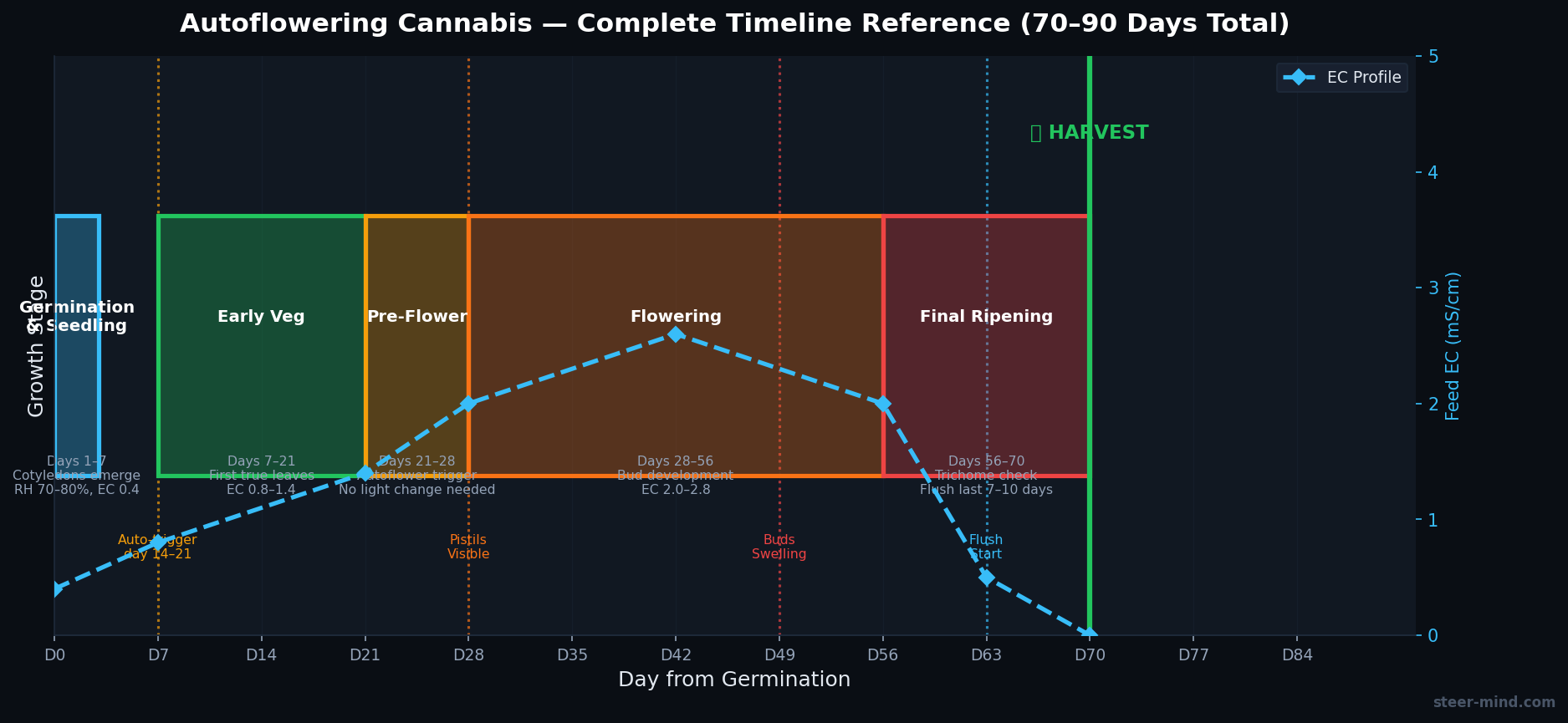
Autoflower Genetics: Cannabis ruderalis and Modern Hybrids
Autoflower cannabis is a cross between Sativa/Indica and Cannabis ruderalis – a wild-growing, cold-hardy species from Siberia and Central Asia. Ruderalis possesses a genetic 'internal clock' triggering bloom after approximately 4-5 weeks of age, regardless of photoperiod.
Evolution of Autoflower Genetics
F1 Generations: Early hybrids, often unstable. Size and maturity vary, not all flower reliably. Not recommended.
F3-F5 Generations: Modern, stable autoflowers. Genetics are fixed – reliably reproducible. This is today's standard.
Modern F5+ Autoflowers: Bred for size, potency, and stability. Some strains reach 100-120 cm height. The difference to photoperiods is now minimal, except for flowering time and stress sensitivity.
Core Difference: Autoflowers don't track their age – only the light hours elapsed. It's a net-time-based process from germination, not photoperiod. This has enormous implications for training and error tolerance.
Lifespan and Maturation
Standard is 70-90 days from germination to harvest. Early strains (60-70 days) are small and fast. Slower ones (90-100+ days) grow larger and more potent. Genetics determine this.
Unique Growing Characteristics
No Second Chances for Mistakes
With photoperiods, you can keep a plant in veg for 3 months and fix errors. Autoflowers flower by week 4. An error in week 1 can't be remedied. Consequences:
- Germination mistakes = lost week
- Pest infection week 3 = permanent damage
- Light stress week 2 = permanently smaller plant
- Overwatering early = root rot
Pot Size is Critical
Autoflowers should NOT be transplanted. Transplanting causes stress and growth pause – fatal for autos. Use the final container from germination: 10-15 liters for most strains.
Small pots (<5L) limit root growth, resulting in smaller plants. Large pots (20L+) are okay but lead to longer veg and higher overwatering risk.
Golden Rule: One final 11-15L container from germination onward. Growth tempo and moisture dynamics are well-calibrated.
Stress and Male Flowers
Autoflowers are more stress-sensitive than photoperiods. External stress (light stress, nutrient deficiency, temperature swings, overwatering) often triggers hermaphrodite development – male flowers form. This is more common than with photoperiods.
Prevention: gentle treatment, consistent conditions, avoiding transplants and aggressive training.
Light Schedule and Intensity
18/6 vs. 20/4 vs. 24/0
| Schedule | Light Hours | Advantages | Disadvantages | Recommendation |
|---|---|---|---|---|
| 18/6 | 18h light, 6h dark | Standard, energy-efficient, good balance | Slightly less photosynthesis than 20/4 | Best choice for beginners |
| 20/4 | 20h light, 4h dark | More light, ~5% higher yield | Higher electricity, short dark phase | For pros with electricity budget |
| 24/0 | Constant light | No interruption | No dark phase for regeneration, highest power use, less sugar breakdown | Not recommended |
Light Intensity (PPFD)
Germination to Week 2: 150-300 µmol/m²/s. Too-strong light causes stress and bolting (long, thin internodes).
Weeks 2-4 VEG/early bloom: 400-600 µmol/m²/s. Increase gradually.
Bloom (Week 4+): 600-900 µmol/m²/s. Optimal for flower and cannabinoid production.
Maximum: Don't exceed 1200 µmol/m²/s – light stress (bleaching, necrosis). Autos are more sensitive than photoperiods.
Beginner Mistake: Starting at max lamp power. Result: burned seedlings, stressed plants. Ramp up slowly – this is the key.
EC Plan and Nutrient Management for Autoflowers
Autoflowers need fewer nutrients than photoperiods because they're smaller and shorter-lived. Aggressive EC (>2.0 in early bloom) is counterproductive.
Weekly EC Plan
| Week | Phase | EC Range | Focus | Notes |
|---|---|---|---|---|
| 1-2 | Seedlings | 0.4-0.8 | Very low – seed reserves sufficient | Just water or ¼ dose nutrients |
| 3-4 | Vegetative | 0.8-1.2 | Nitrogen for growth, but dosed carefully | Watch for over-fertilization = toxicity |
| 5-6 | Bloom Start | 1.2-1.6 | Transition to P/K, N still important | First flowers visible, stretch active |
| 7-9 | Full Bloom | 1.4-1.8 | P/K for flowering, reduce N | Peak nutrient demand |
| 10+ | Finish | 0.6-1.0 | Wind-down (flush) or minimal EC | Nutrient depletion, maturation |
Common Mistake: Too-High EC
EC 2.0+ is overload for autos. Symptoms: discolored leaf tips, curling, stunted growth. Fix: 50% water change and drop EC to 1.0.
Calcium and Magnesium
In coco and fast-growing autos, calcium is often limiting. Supplement: 100-150 ppm calcium separately or via calmag product. Magnesium: 30-50 ppm additionally.
Training and Stress Avoidance
What Works: Gentle LST
Mild Low Stress Training from weeks 2-3 is acceptable. Gently bend branches downward with ropes, without breaking. Accelerates lateral growth without major stress.
What Does NOT Work
- Topping/FIMing: Too stressful, reduces yield
- SCROG: Excessive daily management, net-introduction stress
- Aggressive Defoliation: With only 70-90 days, stress impact is disproportionately large
- Transplanting: Absolutely to avoid – growth pause is fatal
Best Auto Strategy: Passive – give space, good light penetration, care-free cultivation. Training = minimal. Simplicity = higher yields.
Because autoflowers can't be held in veg, the harvest window is narrower. Most autoflowers signal readiness between days 60–85 from seed. Start checking trichomes from day 55. The window from peak milky trichomes to 20% amber is often only 7–10 days — shorter than photoperiod strains where you have 2–3 weeks. Check trichomes every 2 days in the final stage, not weekly.
The 5 Most Common Autoflower Mistakes
Mistake 1: Transplanting or Repotting
Root disturbance = growth halt. With only 70-90 days you lose 10-15% of cycle.
Mistake 2: Too-Aggressive Fertilization
Autos are more sensitive to salt accumulation. EC over 1.8 rapidly leads to toxicity.
Mistake 3: Early Light Stress
Too-intense light in weeks 1-2 causes bolting and abnormal growth.
Mistake 4: Overwatering
Especially early. Roots need air. Over-wet substrate leads to root rot.
Mistake 5: Late Harvest
Larger autos can need weeks 12-14. Too-early harvest means weak potency. Over-ripe is also not optimal.
Outdoor Growing with Autoflowers
Autoflowers excel outdoors due to speed and robustness. They don't need specific light conditions. Natural light cycles are perfect.
Timing: Sow in spring for summer harvest. In warm climates, 2-3 harvests per year possible.
Advantages: Fewer pests (short cycle), fast harvest, zero electricity.
Disadvantages: Weather-dependent (rain, cold, late frost). Rain protection is important.
Autoflower vs. photoperiod: key differences for growers switching between types
Growers experienced with photoperiod cannabis often make preventable mistakes when growing autoflowers for the first time. Understanding the fundamental differences in plant physiology and time sensitivity prevents most of these errors.
| Factor | Autoflower | Photoperiod |
|---|---|---|
| Trigger for flowering | Age (genetic timer, ~3–5 weeks) | Light cycle (12/12 or longer nights) |
| Total grow time | 60–90 days from seed | 90–180+ days (veg controllable) |
| Recovery time after stress | Minimal — stress = permanent yield loss | Days to weeks — can recover fully |
| Transplanting | Avoid if possible — stress during critical window | Transplant freely in veg |
| Training methods | LST only — no topping, no HST | All training methods applicable |
| Light schedule flexibility | 18–24h light throughout (no flip needed) | Must flip to 12/12 to induce flower |
Frequently Asked Questions
Can autoflowers be cloned?
Theoretically yes, practically no. A clone inherits the genetic 'clock' of the mother. If mother starts flowering at week 5, the cutting will too – regardless of age. Autoflower cuttings are essentially useless. Autos are always grown from seed.
Why did my autoflowers stay so small?
Common causes: 1) Early transplanting or stress weeks 1-3, 2) Too-low EC (nutrient deficiency), 3) Insufficient light (<400 µmol/m²/s), 4) Cold temperatures (<18°C), 5) Early overwatering. Autoflowers have only 70-90 days – every stressor counts double.
Do I need a 12/12 light switch for autoflowers?
No. Autoflowers flower regardless of light cycle. 18/6 or 20/4 is standard. 24/0 is theoretically possible but provides less sugar breakdown in dark phase. Dark phase is important for metabolism – plants need regeneration time.
What light duration is optimal for autoflowers?
18/6 (18h light, 6h dark) is standard and efficient. 20/4 enables more photosynthesis, costs more electricity, and yields ~5% more. 24/0 is not recommended – dark phase supports important regeneration. Outdoor: natural light cycle is perfect.
How do I identify harvest timing for autoflowers?
Same criteria as photoperiod: trichom color (milky-white ideal), pistil darkening (70-90% orange). Timing is tighter – after weeks 10-12 some autos ripen very quickly. Weekly inspection from week 8 is essential. Early harvest = immature, weak buds.