Nutrients
Mixing Nutrient Solution: EC Building and Sequence
Correct nutrient solution mixing is the foundation for stable growth. Small errors in sequence or pH lead to precipitation, nutrient lockout, or pH drift. This guide shows the step-by-step process, EC targets by phase, and common mistakes to avoid.
Core Principles
Ion Antagonisms
Nutrients are ions. Some ions can form insoluble salts at high concentrations:
- Ca²⁺ + SO₄²⁻ → Gypsum (CaSO₄): Insoluble, can precipitate
- Ca²⁺ + PO₄³⁻ → Calcium Phosphate: Can precipitate if concentration and pH are wrong
- Mg²⁺ + OH⁻ → Magnesium Hydroxide: At pH > 7.0
Correct sequence and dilution minimize these risks.
Why Dilution Matters
Concentrates have extremely high ion concentrations. Mixing concentrates directly (Part A + Part B) creates local supersaturation and instant precipitation. Dilution with water prevents this.
Golden rule: Never mix concentrates directly. Always dilute with water.
Step-by-Step Sequence
Step 1: Check container and water quality
- Measure reservoir with EC meter (note baseline water EC)
- Hard water (>150 ppm EC): dilute with rainwater or reduce CalMag
Step 2: Fill reservoir to 80%
Water should be room temperature (17–22°C). Leave space for additives and stirring.
Step 3: CalMag first
Add CalMag BEFORE NPK fertilizer. Dosage is usually 1–2 mL/L. Stir thoroughly until no cloudiness.
Step 4: pH buffer (optional)
If using a 2-part system without buffer, add alkaline buffer here (e.g., K₂CO₃).
Step 5: Part A (NPK)
Add Part A after CalMag and stir thoroughly.
Step 6: Part B (Micronutrients)
After Part A, stir for 1–2 minutes, THEN add Part B. Part B has high iron concentrations and could precipitate if not diluted.
Step 7: Additives (optional)
Add supplements after 2+ minutes of stirring.
Step 8: Adjust pH
NOW measure and adjust pH. pH drifts 0.3–0.5 after fertilizer addition. Use pH-Up or pH-Down until target is reached.
Step 9: Measure EC and finalize
After pH correction: measure EC. Should be in target range. If too low: increase EC by 0.1–0.2.
Practice tip: Use a stirrer or magnetic mixer. Manual stirring leads to missed spots and air bubbles.
Always add nutrients to water in this order to prevent precipitation: (1) Fill reservoir with RO/soft water, (2) Add CalMag and stir, (3) Add base nutrient Part A (or combined base), (4) Add Part B if two-part, (5) Add boosters/additives, (6) Adjust pH last. Never mix concentrates together before diluting — calcium and sulfate precipitate immediately when combined without water. If solution turns cloudy after mixing, start over.
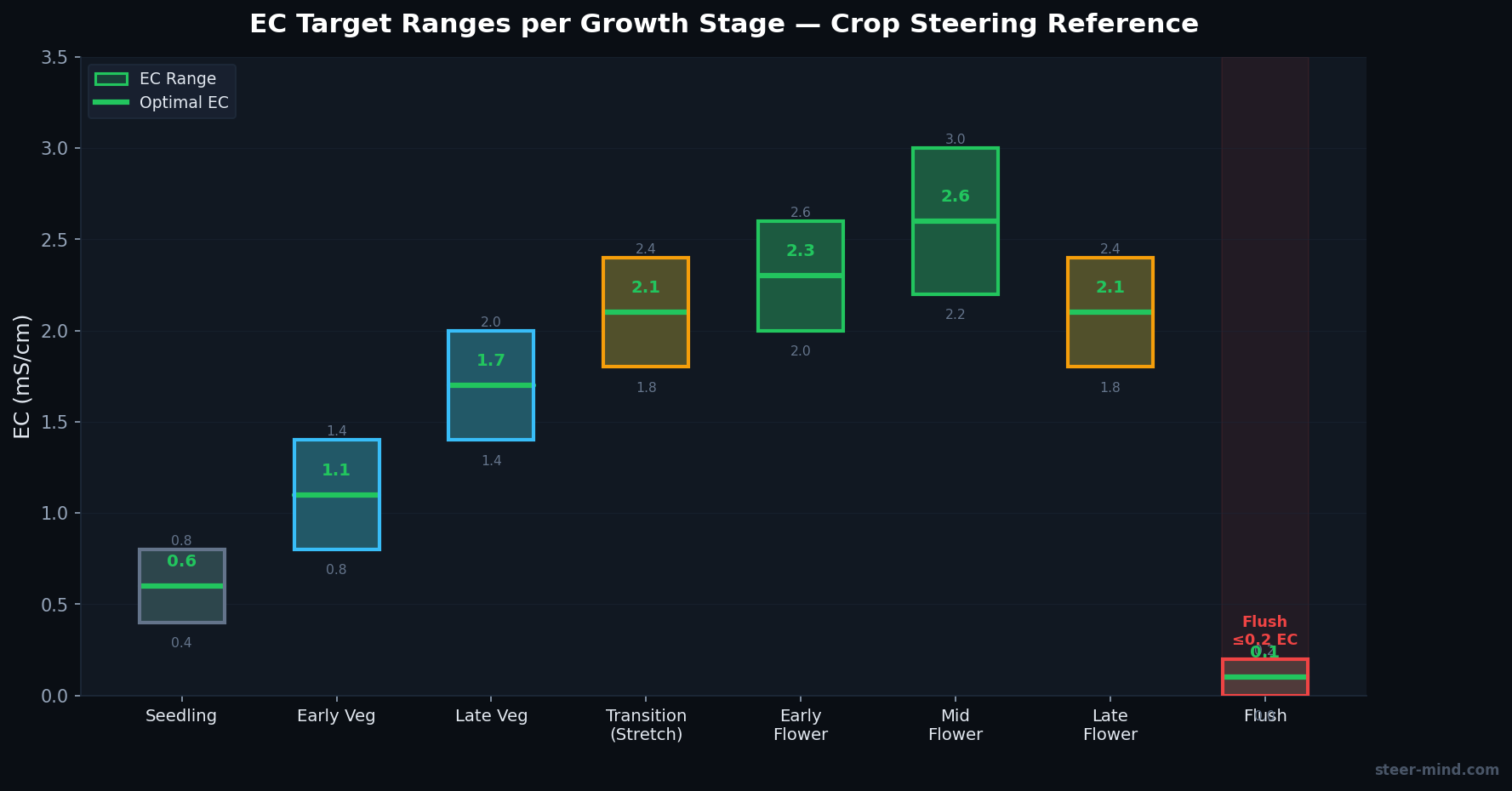
EC Targets by Growth Stage
| Stage | EC Range (mS/cm) | Typical Dosage | Runoff EC Target |
|---|---|---|---|
| Clone/Seedling | 0.6–0.8 | 1 mL/L (1/4 strength) | 0.4–0.6 |
| Early veg (weeks 1–3) | 1.0–1.2 | 2 mL/L (1/2 strength) | 0.7–0.9 |
| Vegetation (weeks 4–6) | 1.2–1.6 | 4 mL/L (full strength) | 0.9–1.2 |
| Stretch (flower switch) | 1.3–1.7 | 4–5 mL/L (bloom formula) | 1.0–1.3 |
| Early flower (weeks 1–3) | 1.4–1.8 | 5 mL/L (bloom) | 1.1–1.5 |
| Mid flower (weeks 4–6) | 1.6–2.0 | 6 mL/L (+ PK booster optional) | 1.3–1.8 |
| Late flower (weeks 7+) | 1.4–1.8 | 4–5 mL/L (reduced) | 1.1–1.5 |
| Flush (final) | <0.3 | No fertilizer, water only | <0.3 |
These values apply to high-quality bloom fertilizers. Budget products may require different targets.
pH Adjustment and Measurement
Target pH by substrate
- Coco/Coconut: pH 5.8–6.2 (ideal 6.0)
- DWC/Hydroponics: pH 5.5–6.0 (ideal 5.8)
- Soil: pH 6.0–6.5 (ideal 6.3)
pH measurement
- Digital meter with 2-point calibration (pH 4.0 and 7.0) before each measurement
- Solution should rest 1–2 minutes after fertilizer addition
- Submerge meter in solution, not touching container walls
- Read when stable (5–10 seconds)
pH adjustment
- pH too low: Add pH-Up (KOH or K₂CO₃), small steps (0.1 units per 1–2 mL)
- pH too high: Add pH-Down (H₃PO₄ or HNO₃), same small steps
- Stir 1–2 minutes after each adjustment, then re-measure
Important: Don't over-calibrate your meter. One calibration per week is sufficient. Daily calibration wears the membrane.
Precipitation Risks and Error Prevention
| Precipitation Risk | Cause | Prevention | Symptom |
|---|---|---|---|
| Gypsum (CaSO₄) | Too much Ca + SO₄ mixed directly | CalMag first, then NPK with delay | White clouds, slow settling |
| Phosphate precipitate | Ca²⁺ + PO₄³⁻ high concentration | Dilute Part A and B separately | Cloudiness, milky |
| Iron hydroxide | pH too high (>6.5) after iron | Adjust pH to 5.8–6.0 before Part B | Red or brown precipitate |
| Mg hydroxide | pH over 7.0 after Mg | Keep pH under 6.2, especially with Mg | White, cotton-like precipitate |
Common mixing mistakes
- Part A and B directly together: WRONG. Always separate with water.
- Adjust pH before fertilizer: WRONG. Adjust after.
- Too little water during mixing: WRONG. Fill to 80% first.
- No stirring: WRONG. Stir constantly.
- Too cold water: WRONG. Use 17–22°C water for better solubility.
Practice tip: If precipitation occurs anyway: don't use. Filter and remix or start fresh. Precipitates block EC meters and sensors.
Frequently Asked Questions
What is the correct mixing sequence?
1. Fill to 80% water, 2. CalMag, 3. pH buffer (optional), 4. Part A (NPK), 5. Part B (micro), 6. Additives, 7. Adjust pH, 8. Measure EC.
Why can't I mix concentrates directly?
Concentrates have extremely high ion concentrations. Direct mixing causes local supersaturation and instant precipitation. Water dilution prevents this.
What are EC targets by phase?
Clone: 0.6–0.8 | Veg: 1.2–1.6 | Early flower: 1.4–1.8 | Late flower: 1.8–2.2 | Flush: <0.3
When should I adjust pH?
AFTER all nutrients are added. pH drifts 0.3–0.5 during fertilizer addition. Adjust then, not before.
What about hard tap water?
Measure baseline EC. If >150 ppm, you already have mineral content—reduce CalMag or dilute with rainwater.